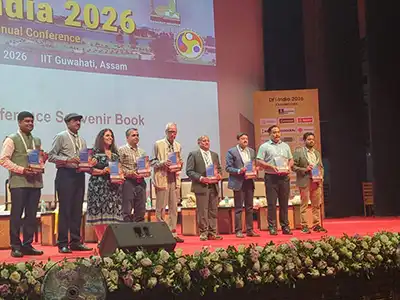
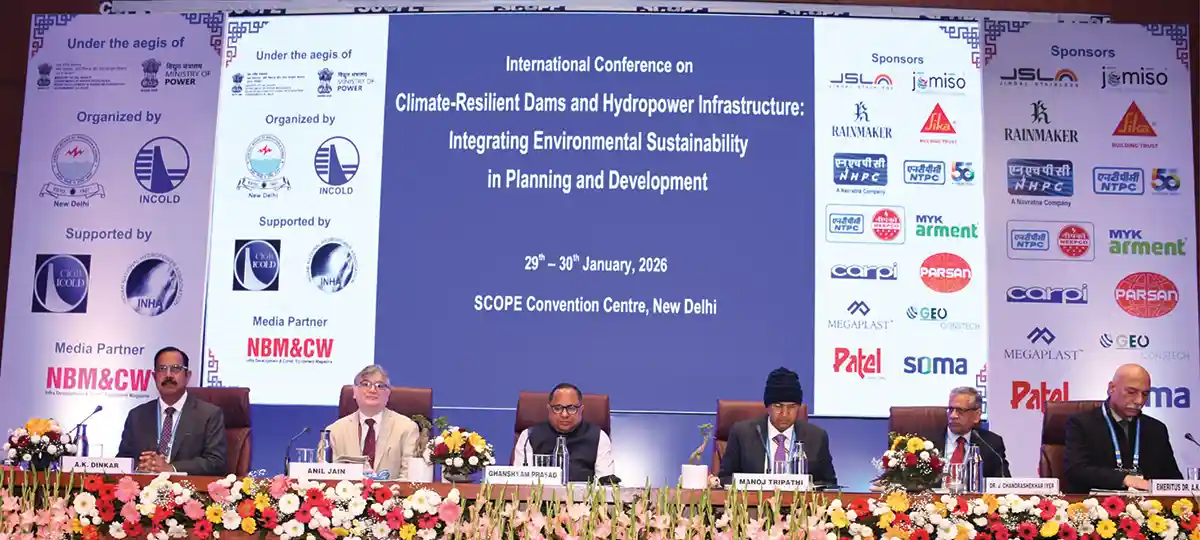
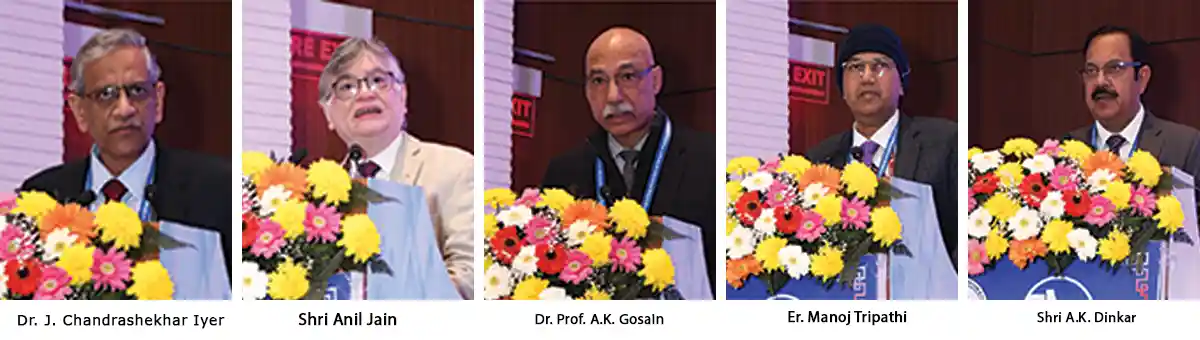
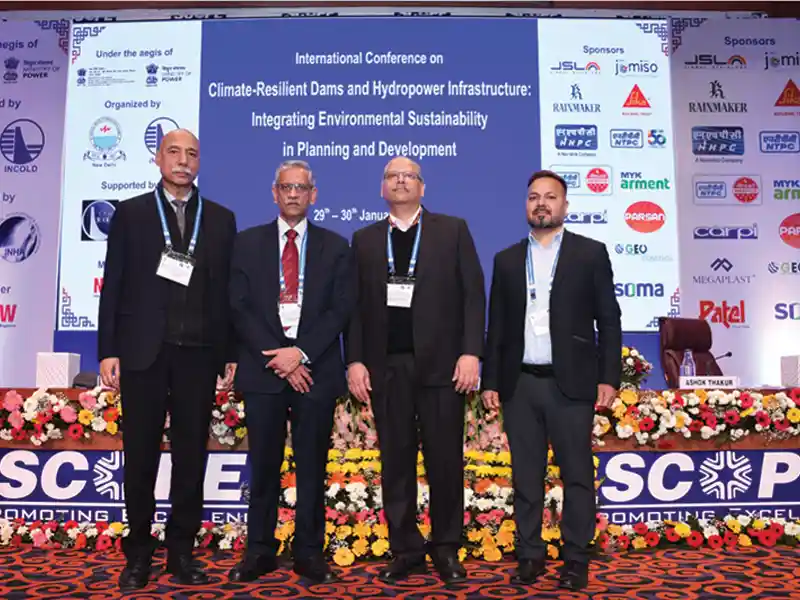
(L–R) Shri A.K. Dinkar, Secretary, CBIP; Shri Anil Jain, Chairman, National Dam Safety Authority; Shri Ghanshyam Prasad, Chairperson, CEA and Ex-Officio Secretary to the Government of India; Er. Manoj Tripathi, Chairman, BBMB; Dr. J. Chandrashekhar Iyer, Chairman, Organizing-cum-Technical Committee and Former Chairman, CWC and Dr. Prof. A.K. Gosain, Emeritus Professor, IIT Delhi, during inaugural session
The two-day conference on Climate-Resilient Dams and Hydropower Infrastructure: Integrating Environmental Sustainability in Planning and Development, organized under the aegis of the Ministry of Power and the Ministry of Jal Shakti by CBIP and INCOLD, and fully supported by the International Commission on Large Dams (ICOLD) and INHA, the Indian National Hydropower Association, was attended by over 200 participants.
The gathering included dam and hydropower professionals from Water Resources Departments, CPSUs, PSUs, consultants, contractors, industry representatives, and material suppliers. The event provided a valuable platform for deliberations on aligning dam and hydropower development with global sustainability goals, with a strong focus on climate adaptation strategies and responsible environmental stewardship.
Dr. J. Chandrashekhar Iyer, Chairman, Organizing-cum-Technical Committee and Former Chairman, CWC, stated that climate change is intensifying extreme events such as floods, droughts, and glacier melt, significantly impacting water availability and hydropower operations. He emphasized that climate change is no longer a distant projection associated with the future; rather, it is unfolding in real time. The devastation witnessed in 2025 such as landslides and infrastructure failures in Uttarakhand, Himachal Pradesh, Jammu & Kashmir, and Punjab, shows the impact of climate change on existing systems. He highlighted the effects of man-made environmental degradation, which compound vulnerabilities. “Climate change and environmental degradation remain constant threats, with visible negative effects – both economically and socially,” he said.
He added, “The hydropower and dam sectors are functionally inseparable. Hydropower generation is intrinsically linked to dam infrastructure, and together they are expected to play a pivotal role in achieving India’s energy transition goals announced at COP26 in 2021, with targets set for 2030 and 2050. Achieving this will require proper maintenance of existing dams as well as construction of new ones, particularly as the country advances toward developing pumped storage hydro projects.”
Shri Anil Jain, Chairman, National Dam Safety Authority, noted that climate change presents one of the most critical challenges, and dams are among the most vulnerable structures in this context. This vulnerability arises from the fact that most dams have been designed assuming a stationary hydrological cycle, an assumption that no longer holds.
Historically, dam design relied on the principle that past hydrological events could reliably predict future conditions, which is why concepts such as return periods were applied. However, with the hydrological cycle now non-stationary, there exists a gap between the design parameters and the actual structural performance, posing significant challenges for dam safety.
Climate change, with its impact on the hydrological cycle, introduces many challenges, particularly concerning floods. Dams previously designed for events with a 1-in-100 or 1-in-1000-year probability are now experiencing extreme floods with increasing frequency. Additional threats include Glacial Lake Outburst Floods (GLOFs). For instance, the Vishnuprayag project in 2011 was severely affected by unusual flood events, and the 2025 monsoon in Himachal Pradesh caused landslides that adversely affected projects such as Malana 1, Malana 2, Parvati 3, Parvati 2, and several others.
He added, “The Dam Safety Act and related regulations provide guidelines and methodologies to brace against these climate change-induced threats. Effective monitoring and management of dams require accurate measurement of conditions and recognition of potential hazards. In line with this, a centralized database, KARMA, has been developed. This system consolidates engineering data, periodic inspection reports, and maintenance activities submitted by dam owners, enabling administrators to monitor and manage the challenges posed by climate change efficiently.”
Based on data collected from dam owners, the Centre for Development of Advanced Computing (CDAC), Pune, is performing dam break analyses for approximately 6,600 dams. The results of these analyses will produce inundation maps, which will be invaluable for disaster preparedness and mitigation planning in the event of dam breaches.
Currently, approximately 370 dams with hydropower potential are registered on the DHARMA portal, of which around 270 are managed by state governments, while the remaining 100 are under the control of the central government and managed through CPSUs. Central agencies and the Ministry of Power can play a vital role in overseeing these dams. These inundation maps, combined with a robust communication methodology, can be effectively utilized to safeguard lives and ensure the protection of dam infrastructure.
Dr. Prof. A.K. Gosain, (Emeritus Professor ) IIT Delhi, noted that India stands at a unique crossroads: on one hand, the country faces increasing climate variability, resulting in more intense floods, prolonged droughts, erratic monsoons, glacial retreat, and rising temperatures. On the other hand, development and growing demand require reliable water storage, flood moderation, irrigation support, and clean energy. Dams and hydropower infrastructure have historically played a crucial and central role in meeting these needs and will continue to do so.
However, the planning, design, operation, and governance of these systems must evolve significantly in response to a changing climate. Climate resilience in dams and hydropower is no longer optional; it is a practical necessity. Extreme hydrological events are testing the safety margins of existing infrastructure, sedimentation rates are accelerating, and downstream communities and ecosystems are increasingly vulnerable. These realities necessitate moving beyond conventional engineering approaches and adopting integrated, adaptive, and ecosystem-sensitive frameworks.
Plenary Session
A key aspect of developing climate-resilient dams is the improvement of forecasting and monitoring tools. Advanced hydrological forecasting, robust real-time data acquisition systems, and digital support platforms are essential to manage the evolving challenges posed by climate variability.
The Conference also underscored the importance of climate risk assessment and scenario-based planning to anticipate extreme events. Adaptive strategies discussed included the use of advanced technical tools such as artificial intelligence, geospatial technologies, and data-driven decision-making systems, as well as nature-based solutions that enhance resilience while preserving ecological integrity. Sustainable infrastructure design, green technologies, improved monitoring systems, and early warning mechanisms were highlighted as critical enablers for balancing energy generation with environmental protection. The discussions further stressed the role of effective governance, regulatory compliance, and policy coherence to ensure that sustainability commitments are successfully implemented on the ground.
The Conference was enriched by international participation, with presentations from experts and delegates from Switzerland, Australia, Nepal, Iraq, Tajikistan, and India, which brought valuable global perspectives and international best practices and experiences, significantly enhancing the technical deliberations.
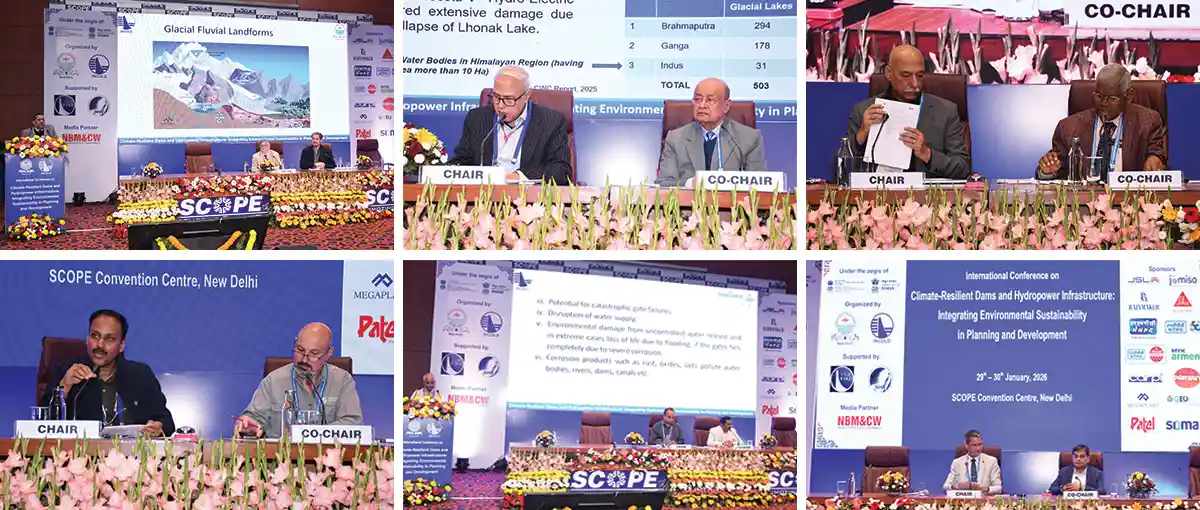
Technical Sessions 1 to 6.
The Conference featured six technical sessions.
Session I focused on Climate Change and Water Resources Management, addressing the impacts of climate change on hydrology and water systems.
Session II examined Climate Change and Environmental Considerations in Dam and Hydropower Projects, highlighting strategies to integrate sustainability into infrastructure planning and operation.
Session III covered Climate Change in the Himalayan Cryosphere, emphasizing glacier studies and risk assessment in high-altitude regions.
Session IV addressed Climate Risk Assessment and Adaptive Planning, along with regulatory frameworks and environmental compliance measures necessary for resilient dam and hydropower management.
Session V explored Nature-Based and Technological Solutions, presenting approaches that combine ecological preservation with innovative engineering. Finally, Session VI focused on AI and Geospatial Technologies, showcasing advanced tools for monitoring, decision-making, and enhancing the operational resilience of water and energy infrastructure.
Shri A.K. Dinkar, Secretary, CBIP, extended his appreciation of the experts and eminent speakers for adding immense value to the conference and inspiring participants to work with renewed commitment towards climate-resilient and environmentally sustainable dam and hydropower infrastructures.