Maehara Naoki, president of Yanmar Compact Equipment’s newly formed Asia, Oceania and Latin America (AOLA) region, has reflected on a fast-paced first six months in charge, marked by economic challenges and a shrinking global construction market. Despite the regional compact equipment market declining by 12% last year, Yanmar CE has increased its market share in AOLA under Naoki’s leadership.
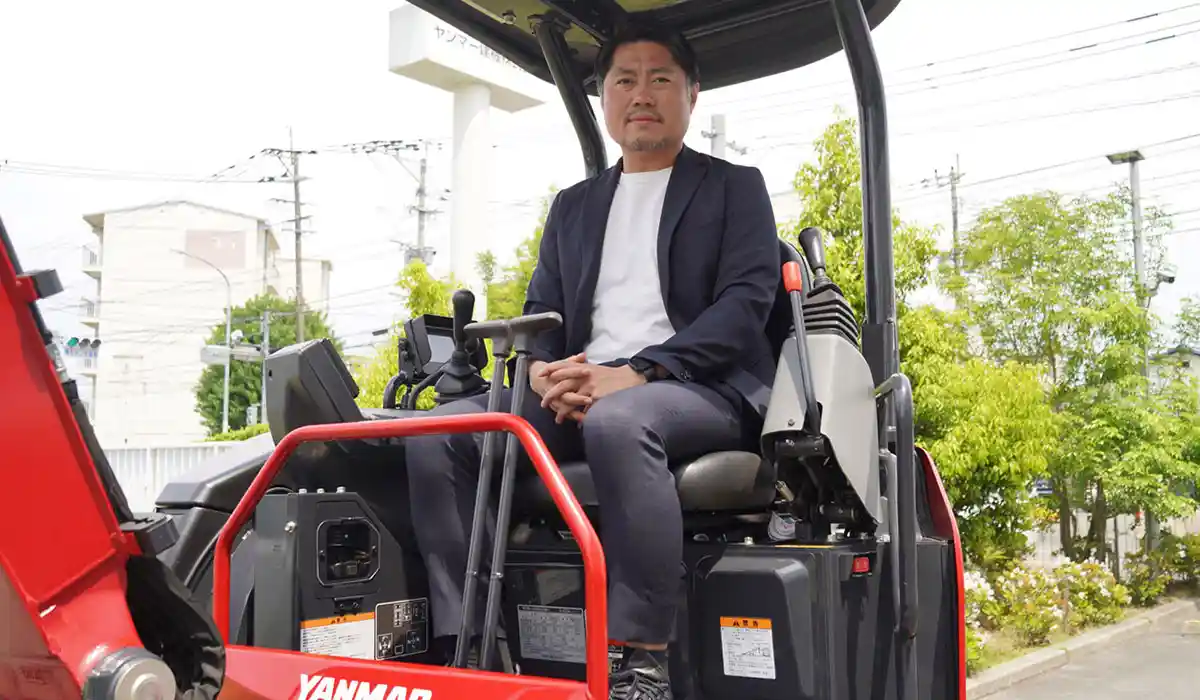
Naoki views the region’s diversity as a source of opportunity, highlighting mature markets like Korea, Australia, and New Zealand, alongside rapidly developing economies such as Brazil and India. “Even though things are still tough, our region offers the highest growth potential for Yanmar CE,” he said, confident that the multi-strategy approach will unlock further growth in the diverse AOLA region.
Premium – but attainable
This diversity has led to a regional strategy that balances premium performance with economic accessibility – a difficult act to pull off. Yanmar’s compact machines, particularly its mini excavators, are engineered for high performance and durability. “Our products are capital goods — they’re not consumer items,” explains Maehara. “So even if our machines are more expensive upfront, their high efficiency and strong second-hand values result in a low total-cost-of-ownership. That’s the argument we’re making – and it resonates with many customers.”
Nevertheless, initial price remains a battleground, especially in developing markets, where lower-cost (often Chinese) manufacturers are active. To stay relevant, Maehara has initiated early-stage discussions with Yanmar’s engineering and product teams about broadening the product portfolio and exploring lower-cost production opportunities. “It’s a multi-year process, but an essential one,” he says.
In the meantime, growth is coming from smart, targeted actions. We have achieved meaningful market share gains in Korea and Brazil — the result of stronger marketing collaboration with dealers and improved local responsiveness. Elsewhere, performance has been mixed.
Sub-regional approach
To manage such regional complexity, Maehara has divided AOLA into six subregions: East Asia, India, China, Southeast Asia, Oceania and Latin America. Each now has its own tailored strategy, to better reflect the unique economic and market dynamics of the territory. “A ‘one-size-fits-all’ approach doesn’t work in AOLA,” he explains. “Our new structure allows us to be more agile and more aligned with local customer needs.”
And agility is very much the watchword. Maehara has begun transforming the internal organization of Yanmar CE in the region, moving beyond a launch structure that consisted solely of commercial experts. In February 2025 two new departments have been created: one dedicated to aftersales and service, and another to regional and subregional strategy. “This allows our commercial team to focus on relationships and sales, while building capability in other areas,” he says. “It’s about maturing our regional organization.”
Target rich environment
Business development for new countries is another area of focus. While the company has established networks in 16 countries, that leaves over a dozen still to explore. Maehara’s five-year plan aims to strengthen distribution in mature markets, grow presence in under-penetrated ones, like India and Thailand, and open new channels in countries where Yanmar CE is not yet present.
Customer and dealer visits have been central to shaping Maehara’s approach. In his first six months, he travelled extensively across the region, learning first-hand how Yanmar CE’s machines fit into real-world business models. “You can’t develop a successful strategy from behind a desk,” he says. “I’ve learned so much by listening to dealers and customers — what they need, what’s working and where we can improve.”
He’s also identified new opportunities. In AOLA, around 15% of compact equipment customers come from the agriculture sector — an area where collaboration with Yanmar’s sister company, active in agricultural machinery, is expected to unlock additional growth. And while mini excavators remain the company’s core product, Maehara sees room to expand into not only mini excavators but also other compact machines, such as skid steer loader and compact track loaders, to accelerate bundle sales with mini excavators.
Momentum is building
While the future is bright, 2025 is not expected to be easy. Market demand is flat, but Maehara remains confident that further market share gains are possible. “We’ve got momentum. We’ve got a plan. And we’ve got an amazing, diverse team that’s full of energy,” he says.
The AOLA team may be new, but Maehara believes its ‘can do’ mentality is a strength. “I tell my team we’re like a start-up inside a global company,” he smiles. “We have to be agile, entrepreneurial – and ready to act fast.”
“I’m really enjoying the diversity of the region — in the markets, the cultures and the team itself,” Maehara concludes. “The market remains tough, but our region offers the highest growth potential for Yanmar CE.”