Throughout my professional journey, I have had the opportunity to interact with almost every stakeholder involved in the construction project management ecosystem - planners, procurement specialists, designers, contract managers, business development teams, finance professionals, quality engineers, safety officers, cost planners, document controllers, marketing professionals, architects, RCC consultants and project managers. Each of these functions contributes significantly to the success of a project. Yet, despite sharing a common objective, I often find them working in isolation rather than as part of an integrated system.Drawing from decades of interaction with professionals across the construction project management ecosystem, Prof. Dr. Sanjay Govind Patil, Director – RICS School of Built Environment, Amity University Maharashtra, Mumbai, examines why fragmentation and silo-based working continue to hinder project outcomes despite rapid technological advancement. He highlights the growing importance of integrated construction project management in connecting people, processes, and digital systems to enable better collaboration, faster decision-making, improved efficiency, and more successful infrastructure delivery in an increasingly complex built environment.

This observation has led me to reflect on a fundamental question: Why do construction projects continue to face delays, cost overruns, disputes, and inefficiencies despite the industry's access to advanced technologies, and highly skilled professionals? The answer, in my view, lies in the lack of integration.
The Challenge of Working in Silos
A construction project is one of the most complex undertakings in any industry. It involves multiple organisations, hundreds of stakeholders, thousands of activities, and countless decisions made over a project lifecycle that can span several years. Success depends not only on the competence of individual teams but also on how effectively these teams collaborate and share information.However, reality often presents a different picture. Planners develop detailed schedules but may not always have complete visibility of procurement lead times. Procurement teams struggle when design revisions are issued late. Site execution teams encounter challenges when drawings are not coordinated across disciplines. Finance departments focus on budgets and cash flows while project teams prioritise progress and delivery. Quality and safety teams are frequently brought into discussions after issues arise rather than being involved proactively from the beginning. Document controllers manage information, yet critical project knowledge remains trapped within departmental silos. Each team performs its designated role efficiently, but the project suffers because the connections between these functions are weak.
An Orchestra Without a Conductor

Construction projects often face a similar challenge. The problem is rarely the lack of expertise; it is the lack of coordination. When information does not flow seamlessly across teams, decisions become fragmented. Delays, rework, contractual disputes, and budget overruns are often symptoms of disconnected project functions rather than technical incompetence.
For a project to succeed, every stakeholder must understand how their decisions impact others across the project lifecycle.
The Technology Revolution in Construction
What makes this challenge even more striking is that today's construction industry has access to technologies that previous generations could only imagine.Building Information Modelling (BIM) enables multidisciplinary teams to collaborate on a shared digital model. Common Data Environments (CDEs) provide centralised platforms where drawings, documents, RFIs, and approvals can be accessed in real time. Enterprise Resource Planning (ERP) systems connect procurement, finance, inventory, contracts, and resource management. Project scheduling tools such as Primavera P6 and Microsoft Project facilitate planning and performance monitoring. Cloud-based collaboration platforms allow stakeholders to communicate and make decisions regardless of their location.
The industry is also witnessing the rise of Digital Twins, Internet of Things (IoT) devices, drones, reality capture technologies, Artificial Intelligence (AI) and Machine Learning (ML). These innovations provide real-time data, predictive insights, automated reporting and enhanced decision-making capabilities. They have the potential to transform project delivery by connecting every phase of the project lifecycle - from concept and design to construction, operation and maintenance. On paper, the industry appears well-equipped to achieve integration; yet the reality is often different.
Technology is Available, but Implementation Remains the Challenge
Despite the availability of sophisticated digital tools, many projects continue to operate through fragmented processes. The challenge is no longer technological capability; it is implementation.Organisations frequently invest in software platforms but fail to transform the underlying processes and behaviours required for integration. Different departments use different systems that do not communicate with one another. Information is repeatedly entered into separate applications. Teams continue to rely on spreadsheets, emails and informal communication channels for critical decisions. As a result, technology often becomes another layer added to existing inefficiencies rather than a solution to them.
In many organisations, digital transformation is viewed as a software procurement exercise instead of a business transformation initiative. Consequently, advanced technologies coexist with traditional silo-based work practices, limiting their ability to create meaningful collaboration. The construction industry does not suffer from a shortage of technology. It suffers from a shortage of integration.
What Integrated Construction Project Management Really Means
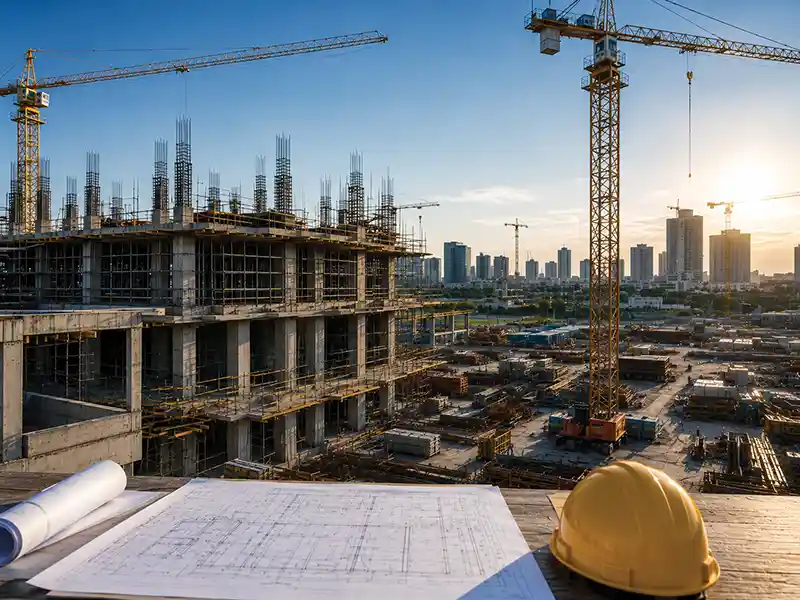
It ensures that planning is linked with procurement, procurement is aligned with design, design is coordinated with construction, construction is connected to quality and safety and all project decisions are supported by accurate and timely information.
An integrated approach promotes transparency, accountability, collaboration and shared ownership of project outcomes. It allows risks to be identified earlier, decisions to be made faster, resources to be optimised and project performance to improve significantly.
Most importantly, integration aligns every stakeholder with the project's strategic objectives rather than allowing departments to pursue isolated functional goals.
Building a Culture of Integration
While technology provides the platform, integration is ultimately driven by people and leadership. Organizations seeking true integration must cultivate a culture where collaboration is valued more than departmental boundaries. Teams should be encouraged to share information proactively, participate in cross-functional decision-making and understand how their actions affect the broader project objectives.Project leaders must move beyond traditional command-and-control approaches and become facilitators of collaboration. Success should be measured not only by individual departmental performance but also by overall project outcomes. Integration requires a common vision, standardised processes, effective governance and a willingness to break down organisational silos.
The Future of Construction Depends on Integration
The future of construction will increasingly depend on integration across disciplines and technologies. As projects become larger, more complex and more sustainability-focused, traditional fragmented management approaches will no longer be sufficient.Smart cities, mega infrastructure developments, transportation systems, green buildings, industrial corridors and digital infrastructure projects demand unprecedented levels of coordination among stakeholders.
Technology will continue to evolve. Artificial Intelligence will become more intelligent, Digital Twins more sophisticated and data analytics more powerful. However, technology alone will not guarantee project success.
The organisations that thrive in the future will not necessarily be those with the most advanced software. They will be those that successfully connect people, processes and digital systems into a collaborative project delivery ecosystem.
Conclusion
From my interactions with professionals across the construction project management family, I have learned one important lesson: projects rarely fail because people lack competence. More often, they fail because information, decisions and responsibilities remain disconnected.Conversely, the most successful projects are those where planners understand procurement challenges, procurement teams appreciate design requirements, finance collaborates with project controls, quality and safety are involved from the outset and technology serves as a bridge rather than a barrier between stakeholders.
Integrated Construction Project Management is therefore not merely a management methodology; it is a necessity for the future of the built environment.
In an era where technology can connect everything, the real challenge is ensuring that people and processes are connected as well. That is why Integrated Construction Project Management truly matters.