With firsthand experience in the execution of the East West Metro Project, Er. Satya Narayan Kunwar, General Manager, Afcons, presents a compelling account of the extraordinary engineering, geological, logistical, and operational challenges involved in India’s first under-river metro tunnelling project beneath the Hooghly River. He highlights the meticulous planning, risk mitigation strategies, international learnings, advanced TBM tunnelling protocols, and multidisciplinary coordination that enabled the successful completion of one of India’s most complex and globally significant underground infrastructure projects.
Introduction
East West Metro Project at Kolkata has made a landmark achievement by successfully completing tunnelling beneath the mighty river Hooghly. The project has twin tunnels of 3.6 km each and 3 underground stations. The project also boasts of constructing one of the deepest metro stations (33.5m deep excavation) and an egress shaft (44.5m deep).This is the first under river metro tunnel in India and has drawn great national and international attention due to the very challenging nature of the project. It took a lot of investigations, case studies, planning, design considerations, and logistic arrangements before plunging into the river.
What makes the project unique and more challenging
It is not only the river crossing that makes this project challenging and unique. The alignment passes through a very challenging topography necessitating tunnelling in the vicinity or directly below very old and dilapidated buildings, railway offices handling critical and sensitive operations, roads and streets brimming to the full, very busy and long railway yards, bridges and flyovers with heavy vehicular traffic, protected monuments, and illegally occupied abandoned buildings.The geology of Kolkata and Howrah is erratic in nature. The topmost strata, especially, is very soft, weak, and prone to settlement. The presence of multiple confined high pressure aquifer systems makes the geology challenging for deep excavation posing the risk of hydraulic heave. The hydraulic heave is a phenomenon, where, after deep excavation, the remaining overburden is unable to overcome the pressure of aquifer system, lowering the factor of safety considerably and risking heave and bursting of overburden soil, and creating instability of underground structures.
Lessons from various international tunnelling projects
Underwater tunnelling has been done around the world, some with successes and some with concerns. The team studied failures that had taken place around the world and built a protocol to avoid them. For example, a tunnel flooding incident in Denmark occurred in 1991 after a weeklong cutterhead intervention, which could have been prevented if the man lock door could have been closed on time. A supply line running across the man lock door prevented door closure quickly, resulting in uncontrolled flooding.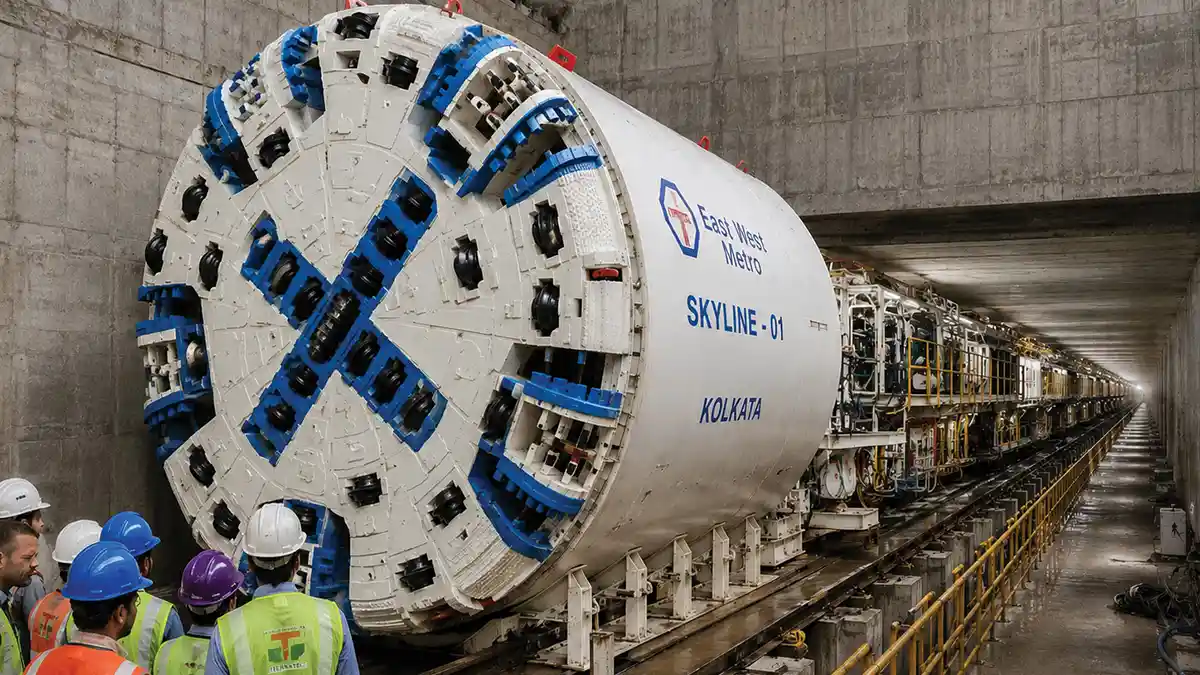
Another tunnel flooding incident took place in Qatar in 2015. It was not exactly in underwater tunnelling, but it hit a strata that had a lot of water. Here too, the screw conveyor gate could not be closed due to low pressure of gas in the pressurisation cylinder, which is actuated during an emergency to close the door.
Underwater tunnelling protocols
Flooding: It is clear that flooding in tunnels can take place even due to very small reasons and hence a robust protocol is necessary. To tackle tunnel flooding, it was ensured that the man lock door is clear all the time during interventions and that there is no compromise in maintaining pressure in the pressurising cylinder.Leakage/Seepage: Leakage/seepage scenarios were studied and ensured that any leakage through joints of TBM shields would be immediately responded to. For example, by pumping Tail Skin Grease and tightening double lip seal bolts of articulation joints and inflating emergency seal if ingress is high. By keeping all such arrangements in hand, the TBM can be converted into a submarine, and issues of flooding / leakage can be addressed suitably.
Keep moving: Continuous mining is key to success. All the necessary materials were arranged in advance for the entire river tunnelling. A minimum of a week’s material was arranged inside the shaft to keep the flow continuous. Nearly 125 trucks of muck were transported everyday through very busy roads and markets. Tunnel crew was deployed round-the-clock with proper overlapping during shift changes. A continuous watch was ensured with the help of elaborate checklists and supervision so that no leakage or flooding traces would go unnoticed. There were no shift changes or holidays/off days observed during river tunnelling.
Harmony with geology: The vertical alignment was designed such that the tunnel passes through stiff clay strata. Soil investigations were done such that bore holes were away from the tunnel alignment to avoid connection of the river with the tunnel. Horizontal alignment in the river was kept straight to avoid any need for manoeuvrings. Face pressure was designed and maintained such that it would not cause over excavation or induce heave in the soil.
Unforeseen surprises: The alignment across river was studied with the help of government authorities to ensure that there was no unforeseen surprises like the presence of any previous jetty foundations, lost ship anchors/shipwrecks, or any previous soil investigation along the finalised alignment.
Intervention before plunging into river: The cutterhead intervention was carried out and necessary cutterhead hard facing was done just before plunging into the river. Only one TBM was pushed at a time for crossing the river, keeping another TBM on standby, so that any spare part requirement beyond inventory could be met on time.
Fast and fierce: With adherence to above protocols, the river tunnelling was completed in 67 days against the planned 127 days. With complete dedication and enthusiasm of the team an engineering marvel was achieved, paving the path and building confidence for future under water tunnelling projects in India.
Other Challenges: River Crossing was a unique challenge as were tunnelling below several old and dilapidated buildings, busy flyovers, railway yards, and important buildings. We had developed a surface management system for negotiating these challenges that helped mitigate concerns related to administrative, safety and public sentiment.
TBMs crossed one of the busiest railway yards of India (500m long) with utmost precision and without disruption to the railway operations. The TBMs also crossed a flyover running along 9 spans of pilled piers. The flyover was part of an arterial route and a major traffic diversion was undertaken involving 450 traffic marshals to ensure smooth traffic diversion that was spread over far and wide areas of Kolkata city.
The flyover was flanked by buildings in very poor conditions, and their evacuation was carried out keeping in mind the occupants. In fact, the evacuation protocol has set a benchmark for future evacuations. There are several other incidents of tunnelling near or below heritage buildings and dilapidated structures, which have given us immense insights and experience for future projects.