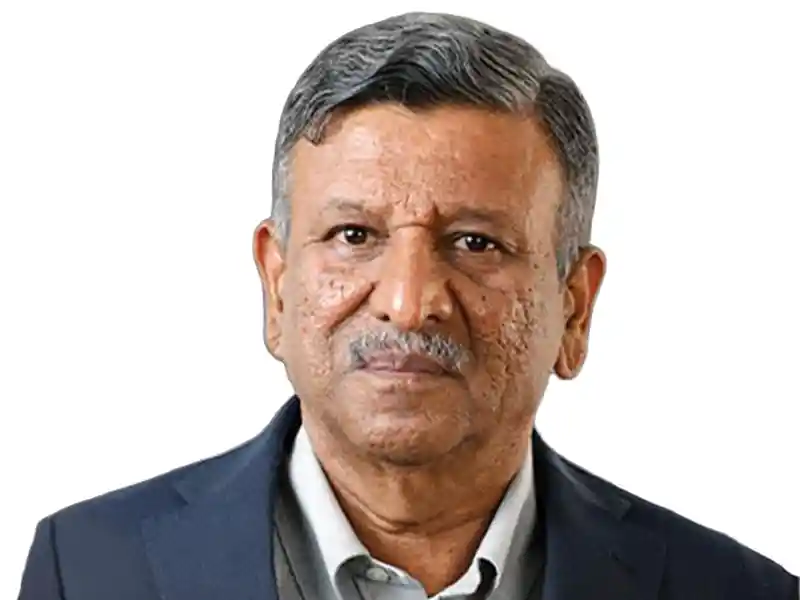
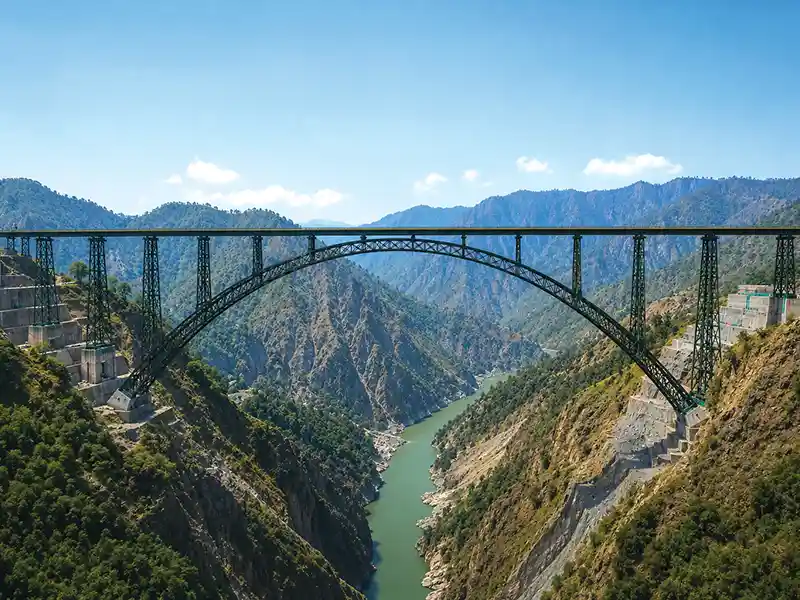
The Chenab Bridge Project stands as one of the most remarkable achievements in modern civil and structural engineering, representing India’s ability to conceive, design, and execute infrastructure of global significance under extreme conditions. Located in the Reasi district of Jammu & Kashmir, the bridge forms a critical link in the Udhampur–Srinagar–Baramulla Rail Link (USBRL) Project, aimed at providing seamless rail connectivity to the Kashmir Valley. Spanning the mighty Chenab River, the bridge is the world’s highest railway arch bridge, towering 359 meters above the riverbed, surpassing even the Eiffel Tower in height.The Chenab Bridge Project represents far more than a remarkable feat of bridge engineering. It reflects India’s growing capability to execute world-class infrastructure under some of the most challenging geographical and environmental conditions. Er. Giridhar Rajagopalan, Deputy Managing Director, AFCONS Infrastructure, highlights the technological innovations, complex construction methodologies, safety systems, and multidisciplinary coordination that enabled the successful delivery of this iconic railway bridge, that set new benchmarks in global infrastructure engineering and project execution.
The project was executed by Afcons Infrastructure Limited (part of the Shapoorji Pallonji Group) under the aegis of Konkan Railway Corporation Limited and Northern Railways. Renowned international consultants and designers, including WSP Finland, Leonhardt Andrä & Partners, and COWI (formerly Flint & Neill), contributed to the project, ensuring adherence to global best practices. With a final contract value of approximately `1,469 crore, the Chenab Bridge exemplifies engineering excellence, innovation, and resilience.
Project Overview and Key Features
The bridge has a total length of 1,315 meters, with a steel arch span of 467 meters, making it the longest steel arch used in railway bridges in India. The arch is parabolic in shape and fixed in nature, while the approach viaducts extend over 2.74 km with horizontal curvature and a gradient of 1 in 400. The deck width varies from 13.5 meters in the viaduct portion to 17 meters above the arch, accommodating railway operational and maintenance requirements.One of the bridge’s most striking features is its structural redundancy. The bridge has been designed such that even in the hypothetical failure or removal of a major structural component—such as a pier or arch member—the structure remains stable and operational at reduced speed. Additionally, for the first time in the world, the bridge was designed to withstand blast loads, in consultation with DRDO, enhancing national security considerations.
Design Considerations and Engineering Challenges
Wind posed another major challenge, with basic wind speeds of 39 m/s as per IS 875 and potential gusts reaching 266 km/h. To address this, extensive wind tunnel testing was conducted at Force Technology, Denmark, using full aero-elastic models. These tests guided the final aerodynamic shape and damping requirements of the structure.
The geological conditions were equally demanding, featuring unstable slopes, fractured rock strata, and steep hill faces. Detailed geotechnical investigations and advanced slope stability analyses were undertaken, supported by institutions such as IISc Bangalore and ITASCA (USA). Extensive slope stabilization measures, rock bolting, cable anchoring, and reinforced retaining systems were implemented at both the Bakkal and Kouri ends.
Logistics and Construction Management
Logistics emerged as one of the most formidable challenges of the project. The bridge site is located nearly 125 km from Jammu, with access roads characterized by steep gradients, sharp curves, and landslide-prone stretches. Initially, both manpower and materials had to be transported using horses and mules, highlighting the remoteness of the site. A central logistics yard was established at Reasi, from where materials were transported to the site using specially selected trailers capable of negotiating tight curves.Close collaboration with the Border Roads Organization (BRO) proved crucial. Roads were widened, slopes cut, temporary bridges strengthened, and retaining structures constructed to facilitate movement of oversized steel components. In several cases, structural elements were redesigned and segmented to allow safe transportation through constrained routes. Mock drills and prototype transportation exercises were conducted to ensure safety and feasibility.
Construction Techniques and Innovations
The erection of the bridge involved a series of first‑of‑its‑kind construction techniques. Mighty pylons, rising up to 127 meters, were erected using indigenously developed climbing cranes. A 915‑meter span cable crane system, one of the longest in the world, served as the lifeline of the project for erecting arch segments, piers, trestles, and deck components.Arch construction was executed through segment‑by‑segment erection from both banks, followed by precise arch closure achieved on 5 April 2021. Extreme control of geometry and tolerance was maintained using advanced surveying, GNSS instruments, and mock assemblies. The hollow steel arch was subsequently concreted in multiple lifts, completing this critical phase in October 2021.
Deck fabrication was carried out at fully equipped on‑site workshops at Surandi, Kouri, and Bakkal, featuring CNC cutting, drilling, and advanced welding facilities. Incremental launching of the deck over curved alignments—including combined transition and circular curves—was achieved for the first time globally, culminating in the “Golden Joint” connection in August 2022.
Safety, Monitoring, and Asset Management
Given the high‑risk nature of the project, safety was accorded the highest priority. An average workforce of over 2,000 personnel was deployed, supported by stringent safety protocols, continuous training, and use of advanced fall protection systems. Wind monitoring systems, rescue trolleys, hanging scaffolds, and dedicated height‑work permits ensured safe execution. These efforts earned the project team the prestigious “Ati Vishisht Suraksha Puraskar” from the National Safety Council of India.The bridge is equipped with an advanced Structural Health Monitoring System (SHMS), comprising strain gauges, accelerometers, anemometers, tilt sensors, GNSS, displacement sensors, and extensometers. Data from these instruments feeds into a Smart Asset Management System (SAMS), enabling real‑time monitoring, early warning, and long‑term performance assessment.