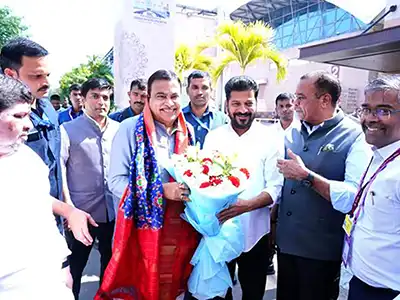
The event was attended by Dr. K. Ilambarithi, IAS, Secretary to Government, Transport, Roads & Buildings Department, Government of Telangana, and Shri Rahul Gupta, Secretary General, IRC, New Delhi, along with other dignitaries, policymakers, senior government officials, road infrastructure experts, engineers, researchers and industry representatives from across the country, who came together to deliberate on the future of India's road and highway infrastructure.
The four-day annual session will feature 19 technical sessions, providing a platform for sharing research, technical knowledge and best practices in road engineering. Discussions will focus on technological advancements, construction methodologies, quality standards, road safety and sustainable infrastructure development.
Addressing the gathering, Shri Nitin Gadkari, Union Minister for Road Transport and Highways, acknowledged the contributions of engineers, contractors and government officials in expanding India's National Highway network. Highlighting the importance of innovation, research and technology in infrastructure development, he said, “Innovation, technology and research form the base of development. The IRC, with its 291 codes, should help shape future road policy and keep following up until governments implement its standards.”
Emphasising the need for quality, transparency and accountability in infrastructure projects, he asserted that there should be no compromise on construction standards or timely execution. He also called for greater adoption of alternative fuels and sustainable construction materials, including ethanol, hydrogen, rice-straw-based bio-bitumen and recycled materials. Highlighting India's dependence on imported fossil fuels, worth approximately ₹22 lakh crore, he emphasised the potential for farmers to become energy providers. On road safety, he noted that India loses approximately 1.8 lakh lives annually in road accidents and urged engineers to take personal responsibility for eliminating accident black spots, with the ultimate goal of achieving zero road fatalities.
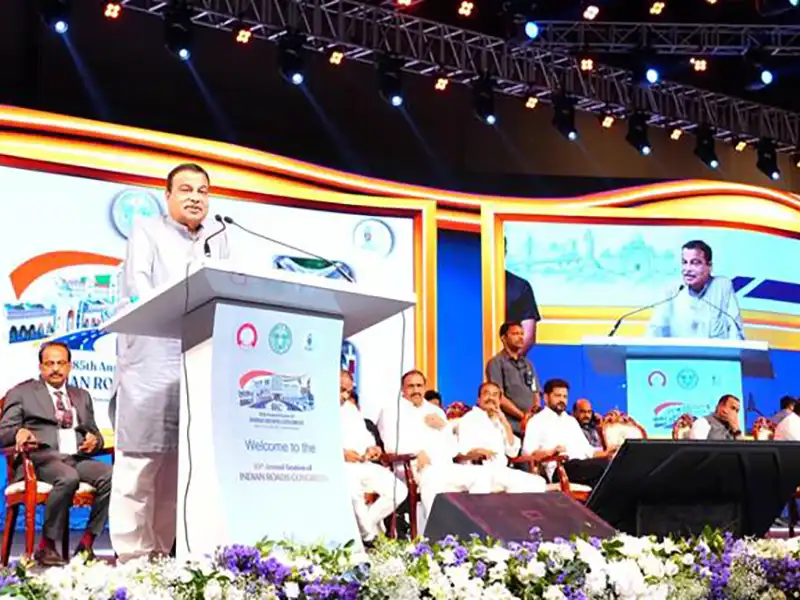
Shri A. Revanth Reddy, Chief Minister of Telangana, outlined the state's long-term economic ambitions under the 'Telangana Rising' vision, which aims to transform Telangana into a USD 1 trillion economy by 2034 and a USD 3 trillion economy by 2047. Emphasising the critical role of road infrastructure in economic development, he said, “Roads are fundamental to national development. Great roads make countries rich and developed.”
Explaining the state's regional development strategy, the Chief Minister highlighted three proposed economic zones: CURE (Core Urban Region Economy), PURE (Peri-Urban Region Economy) and RARE (Rural Agri Region Economy). CURE, covering approximately 2,100 sq. km between the Outer Ring Road (ORR) and Regional Ring Road (RRR), is envisioned as a services-sector hub. PURE is planned as a major manufacturing corridor to serve global markets under the China Plus One strategy, while RARE will focus on agriculture and allied industries.
He emphasised that road connectivity would be central to integrating these three economic zones and strengthening links between cities, villages, industrial clusters and markets. The state's Roads and Buildings Department is undertaking extensive development and upgradation of State and National Highways to improve mobility, accessibility and regional economic connectivity.
Shri Komatireddy Venkat Reddy, Minister for Roads and Buildings, Government of Telangana, highlighted the state's infrastructure development agenda under the leadership of the Chief Minister and acknowledged the Centre's contribution to strengthening India's highway network. He said, “Under the visionary leadership of Shri Nitin Gadkari Ji, India’s national highway network has witnessed remarkable growth, driven by expressways, economic corridors and modern technologies.”
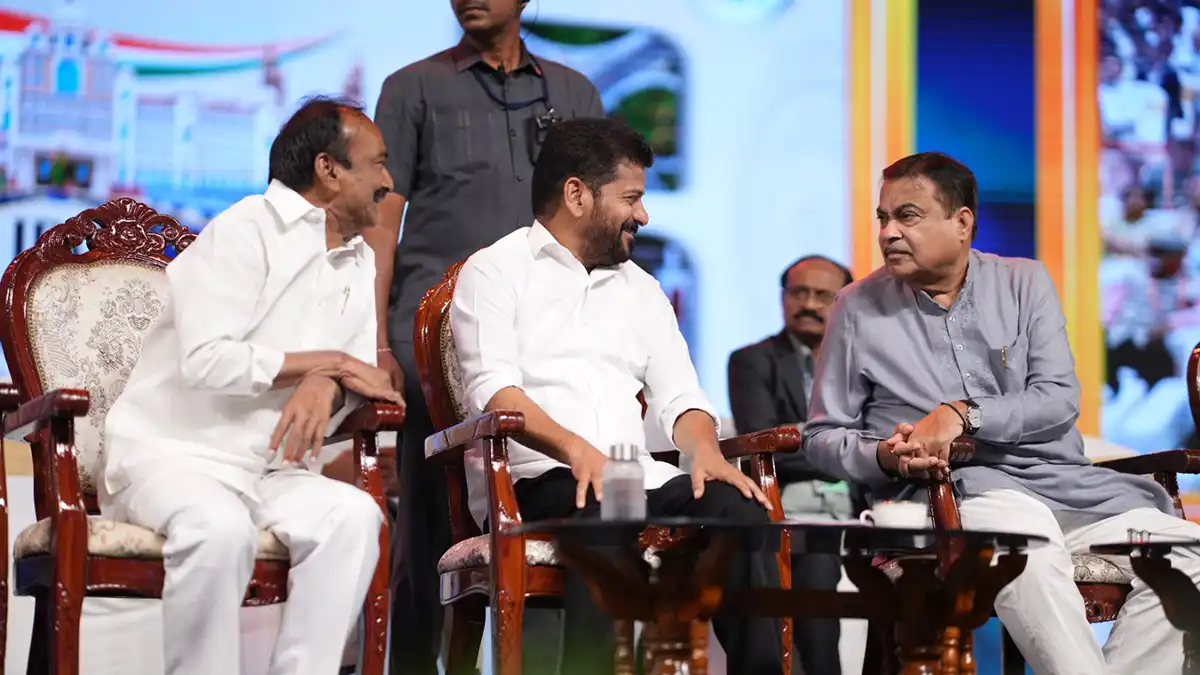
Outlining Telangana's Road Sector Policy, he identified seven key pillars: better connectivity, efficient planning and maintenance, bridging infrastructure gaps, climate resilience, inclusive growth, road safety and smart mobility. He also highlighted the state's Hybrid Annuity Model (HAM) programme, under which 441 roads spanning 6,092 km are being developed with an estimated investment of ₹13,060 crore to strengthen connectivity across districts, mandals and villages.
The Minister sought the Union Government's continued support for several major infrastructure proposals, including a six-kilometre double-decker elevated corridor between LB Nagar and Hayathnagar; five ropeway projects under the Parvatmala Scheme, estimated at ₹1,230 crore; and three Railway Over Bridge (ROB)/Railway Under Bridge (RUB) projects under the Setu Bandhan Scheme.
Other key proposals included six-laning of NH-65 between Hyderabad and Vijayawada, a proposed 61-km elevated corridor between Hyderabad and Srisailam, road works worth ₹1,227.75 crore under the Central Road and Infrastructure Fund (CRIF), and early approval and execution of the northern section of the Hyderabad Regional Ring Road. The state also sought approval for the proposed Hyderabad–Amaravathi Greenfield Expressway, upgradation of 23 State roads covering approximately 2,144 km to National Highway standards, and the establishment of truck terminals along National Highways.
The Minister further proposed setting up an international transport and road works training institute on 67 acres of available government land in Nalgonda district to strengthen professional skills and technical capabilities in the road sector.
The 85th Annual Session of IRC provides an important platform for collaboration between the Centre, state governments, technical institutions and industry stakeholders. With Telangana pursuing its ambitious infrastructure and economic development agenda, the deliberations are expected to contribute to policy discussions and technical solutions for building a safer, more sustainable, resilient and future-ready road network across India.