Highlighting the need to translate planning into implementation, Smt. Thara emphasised the importance of digitising land records, improving coordination among agencies and strengthening government-industry collaboration. She also urged the real estate industry to look beyond financial returns and factor in the wider ecosystem costs of development, including water, green spaces, drainage, sewage treatment, roads and safety.
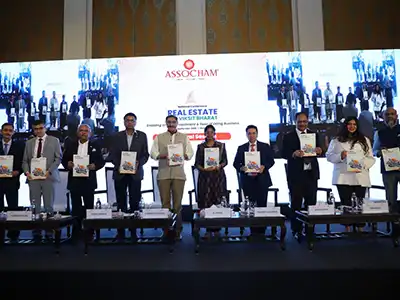
A key highlight of the conference was the release of the ASSOCHAM–Knight Frank (India) Knowledge Report, “Building Viksit Bharat: Real Estate as a Catalyst for Growth.” The report explores how real estate can support India’s economic growth, investment and urban transformation, with the sector providing the physical foundation for households, businesses, manufacturing, services, logistics and emerging areas such as digital infrastructure.
The report highlights that real estate and ownership of dwellings have contributed around 7% of India’s annual GVA over the past decade, while construction accounted for approximately 12% of total employment in 2025.
Shri Devesh Singh, Member, Real Estate Regulatory Authority for NCT of Delhi, said the focus should be on creating regulation that builds trust across the ecosystem. “The question is not whether we need more or less regulation, but whether we have regulation that creates a trustworthy market—giving confidence to consumers, developers and investors.” He highlighted RERA’s role in strengthening transparency and accountability, while calling for faster grievance redressal, stronger institutional capacity and more effective implementation under RERA 2.0.
Shri Parneet S. Sachdev, Chairman, Real Estate Regulatory Authority, Haryana, called for technology-led evolution of the regulatory framework. He said, “The first decade created a statutory architecture of trust. The second decade, RERA 2.0, must create a technological architecture of trust.” He advocated greater use of AI, data analytics and predictive tools to identify early warning signals in stressed projects and enable timely regulatory intervention.
Shri Pradeep Aggarwal, Chairman, National Council on Real Estate, Housing & Urban Development, ASSOCHAM and Founder & Chairman, Signature Global (India) Ltd., said the next phase of growth requires greater regulatory certainty and faster execution. “Our objective is not to reduce regulation, but to make regulation predictable, transparent and time bound.” He called for time-bound approvals, digital land records, standardised processes and stronger government-regulator-industry collaboration, while highlighting the potential of land pooling, REITs and sustainable urban infrastructure.
Shri Gulam Zia, Senior Executive Director – Research, Advisory, Infrastructure and Valuation, Knight Frank India, said India’s real estate growth story must extend beyond the top eight cities. “The next phase of growth cannot be measured only by what is happening in the top eight cities; we need to bring emerging cities and affordable housing into the mainstream of India’s real estate story.”
During a fireside chat, Shri Chittaranjan Dash, Principal Commissioner, Delhi Development Authority, underlined the importance of private-sector participation in implementing Delhi Master Plan 2047. “The government is going to play the role of a facilitator in the coming days but overall, it is going to be the private sector that’s going to uplift the city.” He highlighted land pooling, redevelopment, transit-oriented development and high-density corridors as important components of Delhi’s future growth and housing affordability.
Shri A.K. Malik, Chief Fire Officer, Delhi Fire Service, called for the real estate sector to move beyond minimum statutory requirements towards proactive safety. He Highlighted, “We are thinking about beyond compliance, which means going over and above the minimum requirements.”
The conference brought together policymakers, regulators and industry stakeholders to deliberate on RERA 2.0, digital land governance, Delhi Master Plan 2047, investment, GCCs, REITs and SM REITs, infrastructure, sustainability, technology and construction safety.
The conference concluded with a vote of thanks by Shri Saurabh Sanyal, Secretary General, ASSOCHAM, reaffirming ASSOCHAM’s commitment to strengthening government-industry collaboration towards a transparent, resilient and investment-friendly real estate ecosystem.