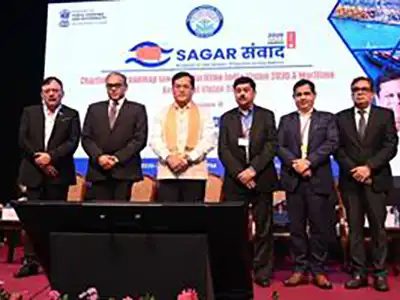
The roadmap was discussed at the first ‘Sagar Samvad’, organised by the NSB in New Delhi under the theme “Charting the Roadmap Towards Maritime India Vision 2030 and Maritime Amrit Kaal Vision 2047”. The event brought together senior government officials, shipowners, financiers, maritime experts and young cadets.
Union Minister for Ports, Shipping and Waterways Sarbananda Sonowal chaired the inaugural edition and launched the NSB’s official website. NSB Chairperson Sameer Kumar Khare also submitted the board’s annual report for 2025-26 and its subcommittee reports containing policy recommendations.
The five-point roadmap focuses on fiscal reforms, assured cargo support, access to competitive financing, regulatory streamlining and ease of doing business. The measures are aimed at improving the competitiveness of Indian shipowners and increasing the country’s share in domestic and international cargo movement.
Sonowal said India currently pays nearly $75 billion annually in freight to foreign shipping lines for transporting commodities such as crude oil, gas, coal and urea. He said strengthening the domestic merchant fleet would help India retain a larger share of this expenditure within the country.
The NSB said Indian-flagged ships currently face a cost disadvantage of around 16% to 20% compared with foreign-flagged vessels. Industry representatives attributed the gap to taxes on ship imports and maintenance services, taxation of seafarer wages and freight, as well as higher domestic financing costs.
The proposed measures could help India add 100 ships to its merchant fleet within five years and support the country’s ambition to become one of the world’s top five ship-owning nations under the Maritime Amrit Kaal Vision 2047.
Sonowal also highlighted the government’s plans to expand port capacity to 10,000 million tonnes per year by 2047, stressing that Indian shipowners should participate in the growth of the country’s maritime trade.
The event also focused on India’s maritime workforce. Union Minister for Labour and Employment and Youth Affairs and Sports Mansukh Mandaviya chaired a session on “Maritime Labour Force: Opportunities and Challenges”, which examined employment, seafarer training, workforce development and emerging opportunities in cruise shipping and advanced shipbuilding.
Mandaviya said India has an opportunity to become a leading global supplier of skilled seafarers and called for stronger industry-led training, wider employment opportunities, greater participation of women and specialised skills for emerging maritime segments.
Union Minister of State for Ports, Shipping and Waterways Shantanu Thakur chaired a session on “Augmentation of Indian Tonnage: Opportunities and Challenges”. The discussion examined the competitiveness of Indian shipping companies and measures required to increase domestic tonnage.
The first edition of Sagar Samvad brought together stakeholders across three sessions focused on maritime policy, workforce development and fleet expansion. The discussions are expected to support the implementation of Maritime India Vision 2030 and Maritime Amrit Kaal Vision 2047 and strengthen India’s position as a competitive global maritime nation.