Electric spark meets earth
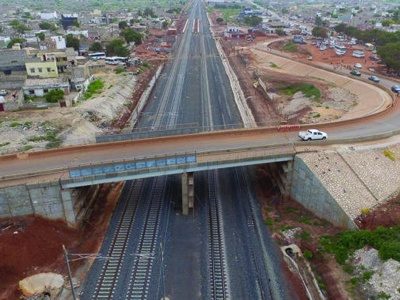
Electricity and soil may appear to be worlds apart, but when they meet through electrokinetics, they mark a story of revolutionary change. In 1809, this era began when Reuss first observed water molecule movement through clay on application of an electric field (Gingine et al., 2013; Abiola and Zalihe, 2020). Later, in 1939, Casagrande applied this breakthrough phenomenon to stabilize a long railroad cutting in Germany, proving that an electric spark could literally reform weak, waterlogged soils into ground steady beneath steel tracks. Since then, modern breakthroughs have turned this phenomenon into a powerful engineering tool, redefining the future of geotechnical innovation worldwide.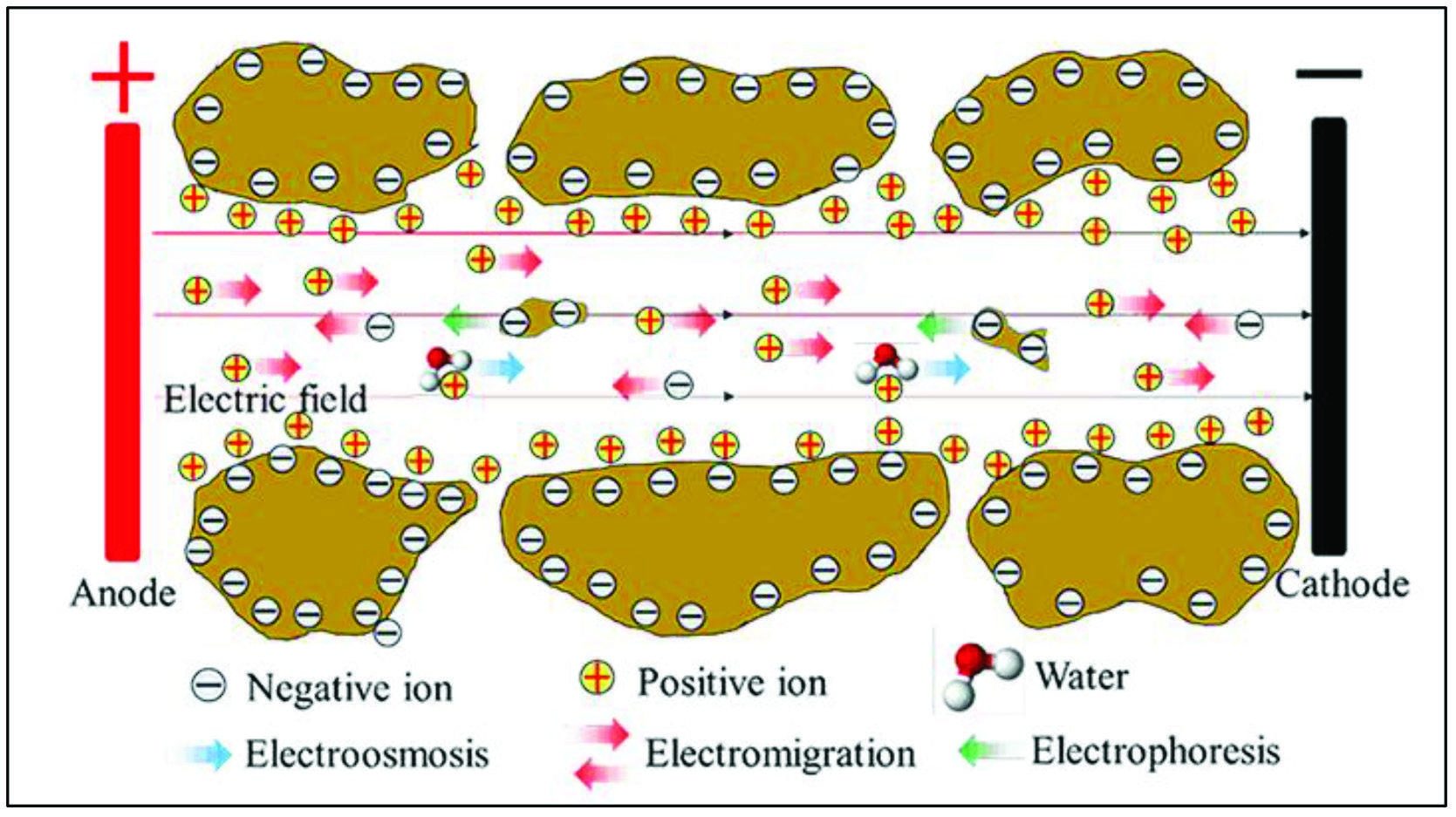 Figure 2: Electrokinetics: guiding water and ions underground (Source: https://www.multiphysics.us/electrokinetics.html)
Unseen obstacles of soft/problematic sediments
Soft/problematic soils are the perennial unseen obstacle beneath our feet. These soils exhibit high compressibility, high swelling potential and low hydraulic permeability which deform on application of load like sponges, swell like dough. For engineers, construction on such a soil is like constructing a skyscraper on a mattress where the foundation sinks, shifts or refuses to stay firm.Traditional consolidation techniques rely on slow, gravity-driven drainage through vertical loads in soils which may extend over months or years to achieve stability. Due to the stubborn nature of soft soils, infrastructure projects face extreme challenges in terms of cost, unpredictable duration and stability. That is why geotechnical engineers need to pursue novel solutions, and why electrokinetics emerges as a promising breakthrough approach, offering accelerated, well-regulated consolidation where traditional approaches lack.
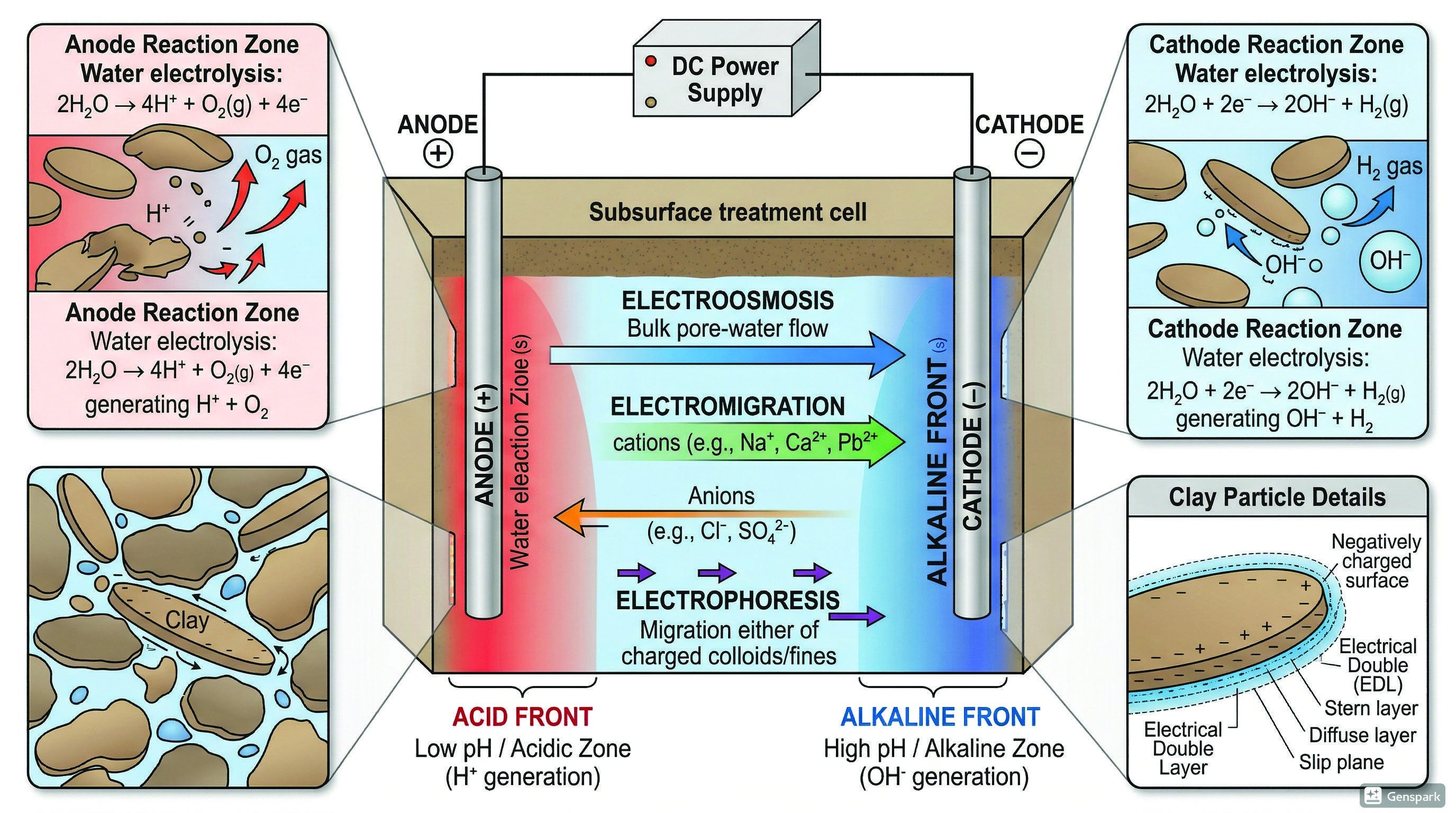
Electrokinetics is a technique that applies electric potential to soil to direct the movement of water and ions. This technique enhances drainage, accelerates consolidation, and modifies soil chemistry to improve stability (Malekzadeh, 2016).
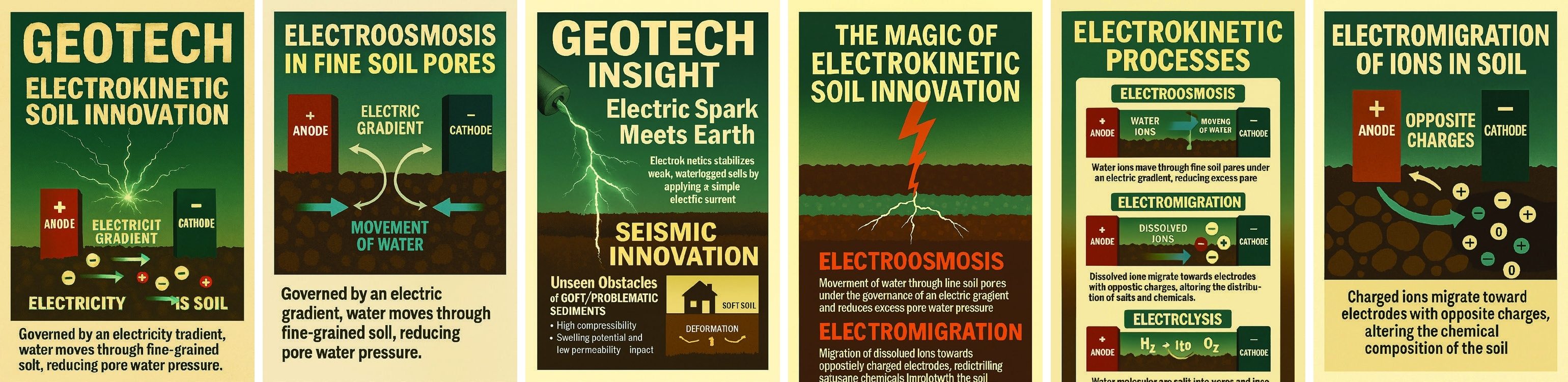
- Electroosmosis → Movement of water ions through fine soil pores under the governance of an electric gradient and reduces excess pore water pressure.
- Electromigration → Migration of dissolved ions towards oppositely charged electrodes, altering the distribution of salts and chemicals throughout the soil mass.
- Electrolysis → Splitting of water molecules into gases and ions at electrodes, initiating reaction leading to alteration of soil properties.
From curiosity to global concern
Electrokinetics is no longer a laboratory experiment; it has become a real-world solution for geotechnical and environmental engineers. Studies in different countries have shown how the application of electricity can transform problematic soil into usable land. Some of the global case studies are mentioned below:- Stabilization of soils beneath railway tracks in Europe by reducing pore water pressure (PWP) and accelerating consolidation process which improved the track stability and reduced long-term settlement issues (Barker et al., 2004; Jeyakanthan, 2009; Nordin, Tajudin and Kadir, 2013; Azhar et al., 2017; Estabragh et al., 2019).
- Urbanisation in countries like India and China helped in improving soft soil foundation in terms of increased bearing capacity and reduced settlement for residential and infrastructure development (Azhar et al., 2017; Wang and Wiltshire, 2018).
- Marine sediment land reclamation in Asia improved shear strength and reduced water content, making reclaimed land suitable for port and industrial development (Malekzadeh, 2016).
- Mine tailings dewatering using electrokinetic phenomenon, accelerates the water removal percentage compared to gravity drainage, making land faster to reuse for construction and reducing environment related hazards(Fourie, Johns and Jones, 2007; Lee, Shang and Xu, 2016; Shang and Xu, 2019; Niri et al., 2024).
- Contaminated soil remediation through electrokinetic process aids to remove heavy metals like lead, cadmium, arsenic and other harmful pollutants from fine soil sediment where traditional flushing methods fail(Kim et al., 2005; Srivastava, Tiwari and Ramudu, 2007; López-Vizcaíno et al., 2016; Tiwari, K. and R.P ., 2016; Wan et al., 2019; Gnanasundar and Raj, 2020).
Challenges associated with this breakthrough technology
With the advancement of electrokinetic technology, certain hurdles are also associated. Excess amount of heat generation in the vicinity of electrodes which can develop cracks and weakens the bond between soil and electrode resulting in water and ion movement resistance and concentration polarisation and slow down the treatment process. Uneven soil consolidation, distortion in electrodes due to erosion and sudden drop in efficiency with moisture content less than of 10% in sediments (Malekzadeh and Sivakugan, 2021).To counter these setbacks, engineers must maintain precise control over pH and temperature throughout the treatment, ensuring that the process remains stable, effective, and reliable. Yet, these obstacles have led to innovation in electrokinetic technology and motivated engineers to merge or transform this fragile technique into a robust engineering tool.
Innovation to turn hurdles into opportunities
Polarity reversal of electrodes prevents desiccation and corrosion at the anode, ensuring steady electric current flow (Huang et al., 2013; Mena et al., 2016; Yoshida, Kitajyo and Nakayama, 2017; Fu et al., 2018). Alternating current (AC) application accelerates consolidation process reduces duration, costs and increases energy savings a. Introduction of chemical solutions accelerates ion exchange and stabilize soft soils, protecting dessication of electrodes (Abou-Shady and El-Araby, 2024).Most importantly, electrokinetic geosynthetics (EKGs), corrosion-resistant polymer electrodes shaped into versatile 2D or 3D forms — have revolutionised new frontiers in the field of problematic soil sediment consolidation and remediation, slope stabilization, tailings dewatering and nuclear waste management (Jones and Glendinning, 2006; Azhar et al., 2014; Tajuddin et al., 2014; Jones et al., 2017; Babu et al., 2020, 2021; Xiao, Guo and Zhuang, 2021a, 2021b).
Conclusion: Future vision of this new global practice
Electrokinetic consolidation has rapidly emerged as a cutting-edge frontier in geotechnical engineering. The inherent presence of charge in soft soils helps direct pore fluid movement in the presence of electric gradients, offering quicker, non-invasive path to traditional soil stabilization and strengthening weak foundation, heavy metal contaminated soil remediation techniques. Evidence from both laboratory and field trials has highlighted its ability to strengthen soft and fragile foundations, reclaiming heavy metals contaminated land, and support ambitious large scale infrastructure projects.Recent advancements in artificial intelligence (AI), particularly physics-informed neural networks (PINNs), are pushing the frontier of electrokinetic in geotechnical field. The AI driven models combine geotechnical physics in predicting the soil behavior with smart real time monitoring in terms of void ratio, compressibility, hydraulic conductivity, and electrokinetic conductivity and optimising design parameters. This reduced the trial and error and back calculation, and made AI integration with large scale electrokinetic more reliable and efficient, opening the gateways for future infrastructure development.
Still, the future of this technique depends on bridging the critical research gaps. New models study are essential for chemo-electro-mechanical behavior of treated soils, while transport phenomena of pore fluids demand deeper investigation. Laboratory and field experiments are needed to capture physico-chemical behavior and soil engineering characteristics. Moreover, soil diversified frameworks must not only extend to soft and contaminated, and optimal design concepts should be introduced for efficieny dealing with voltage, current, electrode spacing, and pH parameters.
References
- Abiola, A.A. and Zalihe, N. (2020) “An Overview of Electrokinetic for Soil Treatment,” (August).
- Abou-Shady, A. and El-Araby, H. (2024) “Reverse polarity-based soil electrokinetic remediation: a comprehensive review of the published data during the past 31 years (1993–2023),” ChemEngineering, 8(4), p. 82.
- Azhar, A. et al. (2017) “Application of Electrokinetic Stabilisation ( EKS ) Method for Soft Soil : A Review,” in International Research and Innovation Summit (IRIS2017). Available at: https://doi.org/10.1088/1757-899X/226/1/012075.
- Azhar, S. et al. (2014) “Monitoring Data of Electrokinetic Stabilisation Method for Soft Clay using EKG Electrode,” pp. 6–10.
- Babu, S. et al. (2020) “Materials Today: Proceedings Experimental investigation on expansive soils using electro kinetic geosynthetics ( EKG ) under cyclic loading,” (xxxx). Available at: https://doi.org/10.1016/j. matpr.2020.06.349.
- Babu, S. et al. (2021) “Experimental investigation on expansive soils using electro kinetic geosynthetics ( EKG ) under cyclic loading,” Materials Today: Proceedings, 37, pp. 1146–1153. Available at: https://doi. org/10.1016/j.matpr.2020.06.349.
- Barker, J.E. et al. (2004) “Electrokinetic stabilisation: An overview and case study,” Ground Improvement, 8(2), pp. 47–58. Available at: https:// doi.org/10.1680/grim.8.2.47.36368.
- Estabragh, A.R. et al. (2019) “Stabilisation of clay soil with polymers through electrokinetic technique,” European Journal of Environmental and Civil Engineering, 0(0), pp. 1–19. Available at: https://doi.org/10.1080/196 48189.2019.1680444.
- Fourie, A.B., Johns, D.G. and Jones, C.J.F .P . (2007) “Dewatering of mine tailings using eletrokinetic geosynthetics,” Canadian Geotechnical Journal, 44(2), pp. 160–172. Available at: https://doi.org/10.1139/T06-112.
- Fu, H. et al. (2018) “Experimental comparison of electroosmotic consolidation of wenzhou dredged clay sediment using intermittent current and polarity reversal,” Marine Georesources and Geotechnology, 36(1), pp. 131–138. Available at: https://doi.org/10.1080/106411 9X.2017.1326992.
- Gingine, V. et al. (2013) “A review on study of Electrokinetic stabilization of Expansive soil,” INTERNATIONAL JOURNAL OF EARTH SCIENCES AND ENGINEERING, 6(2), pp. 176–181.
- Gnanasundar, V.M. and Raj, R.A. (2020) “Materials Today: Proceedings Remediation of inorganic contaminants in soil using electrokinetics , phytoremediation techniques,” Materials Today: Proceedings, (xxxx), pp. 3–9. Available at: https://doi.org/10.1016/j.matpr.2020.03.038.
- Huang, D. et al. (2013) “Coupling interactions between electrokinetics and bioremediation for pyrene removal from soil under polarity reversal conditions,” Clean - Soil, Air, Water, 41(4), pp. 383–389. Available at: https://doi.org/10.1002/clen.201200079.
- Jeyakanthan, V. (2009) ELECTRO-OSMOTIC STABILISATION OF SOFT SOILS SOILS – A NUMERICAL APPROACH.
- Jones, C. et al. (2017) “Electrokinetic geosynthetics: From research to hype to practice,” Proceedings of the Institution of Civil Engineers: Civil Engineering, 170(3), pp. 127–134. Available at: https://doi.org/10.1680/ jcien.16.00039.
- Jones, C. and Glendinning, S. (2006) “Soil consolidation and strengthening using electrokinetic geosynthetics–concepts and analysis,” Geosynthetics. …, (2), pp. 411–414. Available at: http://www. electrokinetic.co.uk/Downloads/E5 Soil Consolidtion and strengthening with EKG.pdf.
- Kim, S.O., Kim, W.S. and Kim, K.W. (2005) “Evaluation of electrokinetic remediation of arsenic-contaminated soils,” Environmental Geochemistry and Health, 27(5–6), pp. 443–453. Available at: https://doi.org/10.1007/ s10653-005-2673-z.
- Lee, J.K., Shang, J.Q. and Xu, Y . (2016) “Electrokinetic dewatering of mine tailings using dsa electrodes,” International Journal of Electrochemical Science, 11(5), pp. 4149–4160. Available at: https://doi. org/10.20964/1009160.
- López-Vizcaíno, R. et al. (2016) “Scale-up on electrokinetic remediation: Engineering and technological parameters,” Journal of Hazardous Materials, 315, pp. 135–143. Available at: https://doi.org/10.1016/j. jhazmat.2016.05.012.
- Malekzadeh, M. (2016) Electrokinetic dewatering and consolidation of dredged marine sediments. James Cook University.
- Malekzadeh, M. and Sivakugan, N. (2021) “Laboratory evaluation of electrokinetic dewatering of dredged marine sediment as an option for climate change adaption,” in IOP Conference Series: Earth and Environmental Science. IOP Publishing, p. 12030.
- Mena, E. et al. (2016) “Electrokinetic remediation of soil polluted with insoluble organics using biological permeable reactive barriers: Effect of periodic polarity reversal and voltage gradient,” Chemical Engineering Journal, 299, pp. 30–36. Available at: https://doi.org/10.1016/j. cej.2016.04.049.
- Niri, S.R. et al. (2024) “Experimental investigation of dewatering silty tailings using electrokinetic method,” Canadian Geotechnical Journal [Preprint].
- Nordin, N.S., Tajudin, S.A.A. and Kadir, A.A. (2013) “Stabilisation of Soft Soil Using Electrokinetic Stabilisation Method,” International Journal of Zero Waste Generation, 1(2), pp. 5–12.
- Shang, J. and Xu, Y . (2019) “Electrokinetic dewatering of mine tailings from hydrometallurgical processes,” Proceedings of the 22nd International Conference on Paste, Thickened and Filtered Tailings, pp. 275–283. Available at: https://doi.org/10.36487/acg_rep/1910_18_shang.
- Srivastava, R.K., Tiwari, R.P . and Ramudu, P .B. (2007) “Electrokinetic remediation study for cadmium contaminated soil *,” 4(4), pp. 207–214.
- Tajuddin, A. et al. (2014) “Monitoring data of electrokinetic stabilisation method for soft clay using EKG electrode.”
- Tiwari, R., K., D. and R.P ., V. (2016) “Electrokinetic Remediation of Copper Contaminated Soils using,” International Journal of Innovative Studies in Sciences and Engineering Technology, 2(6), pp. 18–23.
- Wan, Y . et al. (2019) “Environmental Research on Remediation of Cd- contaminated Soil by Electrokinetic Remediation,” Ekoloji 28(107):, 28(107), pp. 873–881.
- Wang, D. and Wiltshire, J. (2018) “Special issue: Land reclamation and enhancement of soft marine sediment for building,” Marine Georesources and Geotechnology, 36(1), p. 1. Available at: https://doi.org/10.1080/1064 119X.2017.1384898.
- Xiao, F ., Guo, K. and Zhuang, Y . (2021a) “Study on electroosmotic consolidation of sludge using EKG,” International Journal of Geosynthetics and Ground Engineering, 7(2), pp. 1–11.
- Yoshida, H., Kitajyo, K. and Nakayama, M. (2017) “Electroosmot1C Dewatering Under A.C. Electric Field With Periodic Reversals Of Electrode Polarity,” 3937(October). Available at: https://doi. org/10.1080/07373939908917550.
Authors
- Dr. Deep Jyoti Singh, Lecturer, Department of Civil Engineering, Government Polytechnic Kotana, Baraut, Bagpat.
- Dr. Neha, Lecturer, Department of Civil Engineering, Government Polytechnic Kotana, Baraut, Bagpat.
- Dr. Sonam, Lecturer, Environmental biotechnology consultant, Ghaziabad.