Our hybrid manufacturing strategy for developing countries like India significantly reduces freight cost while customers receive equipment with European-quality assurance at a more competitive price.
Eric De Bruin, Director – Business Development

Please walk us through the key projects executed by Moldtech in India and the technologies supplied.
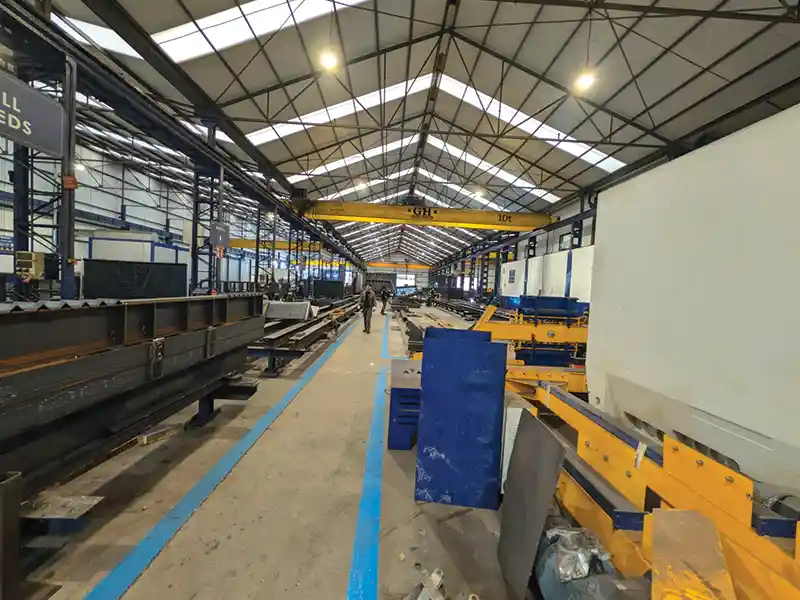
Our first project in India was the Low Cost Housing Project in Narela, North Delhi, in 2013 for which we supplied approximately 1.8 km of beamline to produce non-prestressed beams of various types, as well as a tilting table, and a mold for elevator shafts.Following that, we have worked on several projects with Preca in Hyderabad, supplying Double-T molds, including for an Infosys project in Bhubaneswar. We have executed a project with Shapoorji Pallonji, providing our MT-20 machine for dry-cast box culverts—capable of producing up to 10 culverts per shift—used primarily for pedestrian, bicycle, and three-wheeler underpasses, as well as drainage applications. We have carried out two major carousel-system installations for dry-cast column production: one was in Narela and the other near Taloja in Mumbai.
How has your experience been working with Indian companies and what potential do you see in the Indian market for precast constructions?
Our experience with Indian clients has been extremely positive. They have visited our factory in Spain to see our installations firsthand. During execution, collaboration with the Indian teams has been smooth—even for extensive installations requiring our technicians to stay onsite for over a month.The precast market in India has evolved significantly, especially since 2016, when demand grew rapidly due to factors such as hard-to-find skilled labor since precast with its automation, reduces dependency on manual labor, plus it ensures high and consistent quality, and on-site execution is faster and streamlined.
Today, precast is being widely used for infrastructure development of railways, metros, tunnels, highways, and buildings. There are around 35 large precast plants owned by 23–24 companies, and real estate developers like Sobha, Shapoorji Pallonji, and Hiranandani also have their own plants. So, India’s future market potential for precast construction is huge:
- $30 billion+ planned investment in tunnel construction
- Rapid metro expansion across 27+ cities
- 12,000 km of highways added annually
- Increased focus on precast in government road policies
We are in discussions for a joint venture with some established company in India, and have even considered setting up a manufacturing facility or a local subsidiary in India. A joint venture demands human-resource commitment and active supervision. If a product carries our brand, it must meet our quality standards. That means placing our supervisors onsite during the initial phases to train local teams and ensure that proper processes are established. Only with such oversight can we maintain the performance and reliability associated with our brand.
What technologies of Moldtech have been applied in international construction projects?
We offer several product lines and many of our systems have been used in diverse project applications around the world, which are highly suitable for the Indian market as well. Some of the key technologies and their applications include:- Mobile hydraulic molds for AASHTO-type girders used in highway bridge construction. We executed a turnkey project in Romania featuring four 125-meter production lines, enabling the casting of 3 40-meter girders in each line every 24 hours.
- Hydraulic systems for U-type beams commonly used in metro rail projects. Similar systems have been supplied recently in Egypt for large-scale metro developments.
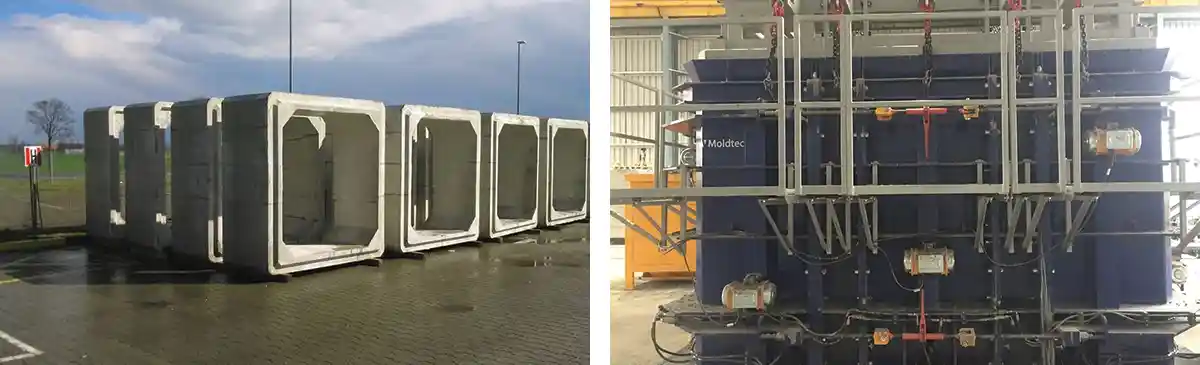
- Hydraulic shrinkable 3D moulds which allow monolithic casting of a module consisting of the walls and the floor or the wall and the top slab.
Please explain how 3D modular molds work and their suitability for both mass housing and premium projects?
These fully finished modules are then transported to the site, lifted by crane, and connected. Steel loops embedded in the modules allow vertical reinforcement bars to pass through, and the joints are grouted to make the structure continuous. No plumbers, electricians, or wet trades are required on the construction site. This technology is already being used successfully in Sri Lanka and is ideal for scalable housing such as G+2 structures, student hostels, military housing, and affordable housing programs. We have also delivered high-rise modular projects; in Singapore, for example, we completed buildings up to 30 floors, driven by the need to minimize heavy on-site activity in dense urban areas.
The system is equally suitable for premium or luxury housing. A standard mold (e.g., 10 m × 3 m) creates a single module, but if one wall is left open and placed beside another similar module, the usable area doubles — allowing flexible configurations even for luxury villas. The key is modular architectural design; layouts must align with mold capability. Molds are adjustable, allowing different lengths and widths within defined limits.
Transportation is the main constraint due to fixed dimensions and weight, so we follow two approaches:
- Onsite manufacturing, as used for 60-ton prison cells in the USA, where transportation was impossible.
- Smaller modules produced in a central plant and connected on site to form larger spaces.
How is seismic performance addressed in modular precast buildings, especially in high-rise projects like the 30-storey example in Singapore?
In Singapore, the modules measured 30 ft x 10 ft. We used a shrinkable inner core mold that contracts to allow substitute for 'Flawless Demoulding' without requiring a conical slope. The mold consists of four corner units, and we insert modular extensions to adjust width and length. Wall thickness can be varied, insulation can be added, and even balconies can be designed. These measures ensure structural integrity while maintaining flexibility in module design.This modular system has been applied successfully in several countries, including Sri Lanka, the United States (for bathroom pods), France, Saudi Arabia, Singapore, and Uruguay.
The modules are connected to each other horizontally and vertically. This can be done by a variety of techniques. For vertical connections many times there are vertical bars in a duct linking the modules. These ducts are then filled with a fresh grouting to create a solid bond between the modules. In order to assure correct grouting one often makes use of so-called grout tubes embedded in the walls of the modules.
Can modular precast buildings be aesthetically appealing, or do they typically look “boxy”?
Absolutely. Aesthetics can be fully addressed using form liners that imprint textures or patterns onto the exterior surface, similar to architectural precast façade panels. Modular construction can therefore achieve visually attractive designs without compromising.Precast isn’t just about reducing construction time—it’s about precision, reliability, and transforming the way buildings are planned and executed. With the right design and technology, even high-rise and luxury projects can be delivered faster, safer, and with superior quality.
How do you integrate technology, such as IoT or automated monitoring into hydraulic precast systems, and how do you ensure precision and prevent issues like hydraulic leaks?
Our steel 3D molds provide highly precise and consistent dimensions. When manufacturing the molds, we define acceptable tolerances, for example, a maximum deviation of less then 4mm over 4 meters, which is extremely precise for concrete. Since the molds are rigid, the geometry remains consistent, unlike in-situ construction where manual methods can bring variations.Hydraulics are used only for opening and closing the mold. Once the mold is in casting position, a mechanical lock secures it, ensuring accuracy and preventing movement. This fail-safe mechanism means precision does not rely solely on hydraulics. Combining this mechanical control with smart monitoring systems allows us to maintain quality, repeatability, and operational safety across all production cycles.
If a contractor or developer approaches you with a building design, how do you advise them on optimizing it for precast construction, along with understanding ROI, cost savings, and the economic advantage compared with in-situ construction?
We provide comprehensive guidance on design optimization, mold utilization, production cycles, and cost modeling. We help developers evaluate payback time, waste reduction, speed advantages, and operational savings when comparing precast to in-situ construction.Precast requires a certain level of standardization which must be taken into account during the design stage. Hence, coordination between the precast factory, contractor, and the architect is essential to make the production process efficient. Even very small design changes can have a huge impact on production costs as a minor size adjustment would require a different table or mold.
In India, real estate developers considering investing in precast systems, especially for large projects of 300,000 to 500,000 sq. ft. or more, are mainly concerned about the cost-benefit of switching from in-situ to precast. However, in precast, the cost advantage is not just in terms of the price per square meter; the greatest value comes from planning, reliability and time savings. Since precast elements are produced ready-for-installation, the process eliminates delays caused by bad weather (such as the monsoon rains) and on-site uncertainties.
In-situ may initially seem cheaper, but delays and on-site complications often increase the final cost. I once visited a precast manufacturer-turned-developer in Canada. He constructs six-storey apartment buildings in one year, which would take at least two years if constructed in-situ. The financial impact of saving an entire year is substantial. Plus, factory-controlled production eliminates wastage of concrete or steel and ensures a more reliable outcome compared to on-site construction.
Although in India, most major contractors understand the concept, there is uncertainty in using a new system. Hence, our strategy to convince them is by showcasing successful international projects. What works in Singapore today could be relevant tomorrow in France or India. Singapore has built 30-storey buildings using our 3D modules. In the United States, we produce complete bathroom pods in just five days. In Romania, we have built a mobile precast factory for bridge girders.
examples demonstrate possibilities and inspire confidence. Mistakes not only cost money—they can halt production. I firmly believe that face-to-face interactions build the trust needed for clients to confidently adopt the new precast construction technology.