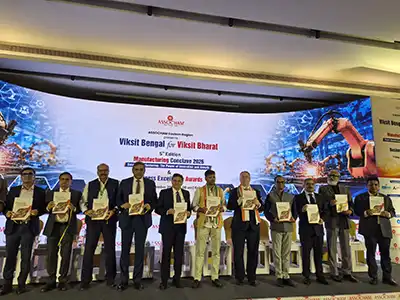
The report examines India's changing manufacturing landscape and the opportunities available in Eastern India, with a focus on West Bengal's industrial ecosystem. It calls for a shift from conventional manufacturing models towards higher value addition, technological advancement, improved productivity and greater integration with global manufacturing networks.
It identifies Eastern India as an important region for diversifying the country's manufacturing base. West Bengal, Odisha and Jharkhand collectively recorded manufacturing Gross State Value Added (GSVA) of approximately Rs 4.50 lakh crore in FY2024-25, compared with Rs 5.42 lakh crore in Maharashtra.
The three eastern states have complementary industrial strengths. Odisha and Jharkhand have established resource-based industries, particularly in metals and minerals, while West Bengal offers a diversified industrial base, established manufacturing clusters and strategic connectivity.
Devroop Dhar, Co-Founder and Managing Director, Primus Partners, said, “The true measure of industrial progress lies not simply in attracting investments, but in enabling enterprises to succeed, industries to flourish and economic opportunities to multiply. It is important to strengthen the broader manufacturing ecosystem through investment-ready infrastructure, regulatory efficiency, cluster modernisation, enterprise development, workforce capabilities and proactive investment facilitation.”
Despite its industrial legacy and geographical advantages, West Bengal’s manufacturing sector faces structural challenges. Its share of India’s GDP declined from 10.5% in 1960–61 to approximately 5.5% in 2024–25. The State accounted for just 2.9% of India's merchandise exports in FY26, with its ten leading products contributing 61.3% of its export basket.
The report identifies considerable opportunities to build on West Bengal’s existing industrial strengths across metals, refining, chemicals, engineering, foundries, textiles, leather, jute and food processing. Emerging opportunities in defence manufacturing, shipbuilding, ship repair, advanced engineering, downstream chemicals and labour-intensive manufacturing could further diversify the State's industrial base.
The state’s strategic location, proximity to resource-rich regions, ports and inland waterways, extensive MSME network, engineering and research institutions, and existing defence manufacturing capabilities provide a strong foundation for industrial expansion. Developments in Haldia, gas infrastructure, waterways and industrial corridors could further support new industrial clusters and downstream industries.
The report outlines a strategic roadmap to strengthen West Bengal’s manufacturing ecosystem through the following key interventions:
- Strengthening industrial competitiveness: Ensuring effective implementation of the new Industrial Policy and improving the reliability and competitiveness of investment incentives.
- Modernising manufacturing clusters: Developing integrated, high-value industrial ecosystems with shared design, technology, testing and certification facilities.
- Expanding investment-ready infrastructure: Strengthening industrial land banks, encouraging private industrial parks and developing plug-and-play facilities.
- Developing sector-specific industrial parks: Prioritising sectors such as defence, shipbuilding, advanced engineering, electronics, chemicals, pharmaceuticals, food processing and textiles.
- Improving investment facilitation: Strengthening Silpa Sathi through GIS-enabled land information, AI-powered investor assistance and end-to-end digital processing.
- Creating a business-friendly regulatory environment: Simplifying compliance, improving approval timelines and strengthening inter-departmental coordination.
- Enhancing MSME competitiveness: Improving access to global markets, technology partnerships, supplier development and quality certification.
- Building a skilled manufacturing workforce: Strengthening industry–ITI partnerships, apprenticeships, work-based learning and continuous skill development.
- Strengthening manufacturing quality: Expanding common testing, calibration and metrology facilities and promoting internationally accepted quality standards.
- Repositioning West Bengal as an investment destination: Promoting the State through a unified investment proposition under the banner “Make in Bengal. Build for the World.”