According to the report, construction equipment sales rose 23 per cent year-on-year to 29,289 units in Q2 FY2026-27 (July–September 2026), after growth of 8 per cent to 25,112 units in Q1.
Key highlights
- Domestic construction equipment sales rose 23 per cent year-on-year to 29,289 units in Q2 FY2026-27, after 8 per cent growth to 25,112 units in Q1.
- Domestic sales are projected at 33,550–38,100 units in Q3 FY2026-27 and 37,350– 41,900 units in Q4.
- Full-year domestic sales are projected at 1,26,500–1,33,500 units in FY2026-27 and 1,33,750–1,40,750 units in FY2027-28.
- Overall capex over FY2027-31 is projected at ₹140–160 lakh crore, 1.4–1.6 times the ₹101 lakh crore invested over FY2022-26.
Performance in H1 FY2026-27
Domestic construction equipment sales were 25,112 units in Q1 FY2026-27 (April–June 2026), up 8 per cent year-on-year. Growth picked up in Q2 (July–September 2026), with sales of 29,289 units, up 23 per cent. The sequential improvement in Q2 signals a pickup in demand following the subdued performance in FY2025-26.Segment-wise domestic sales, Q2 FY2026-27
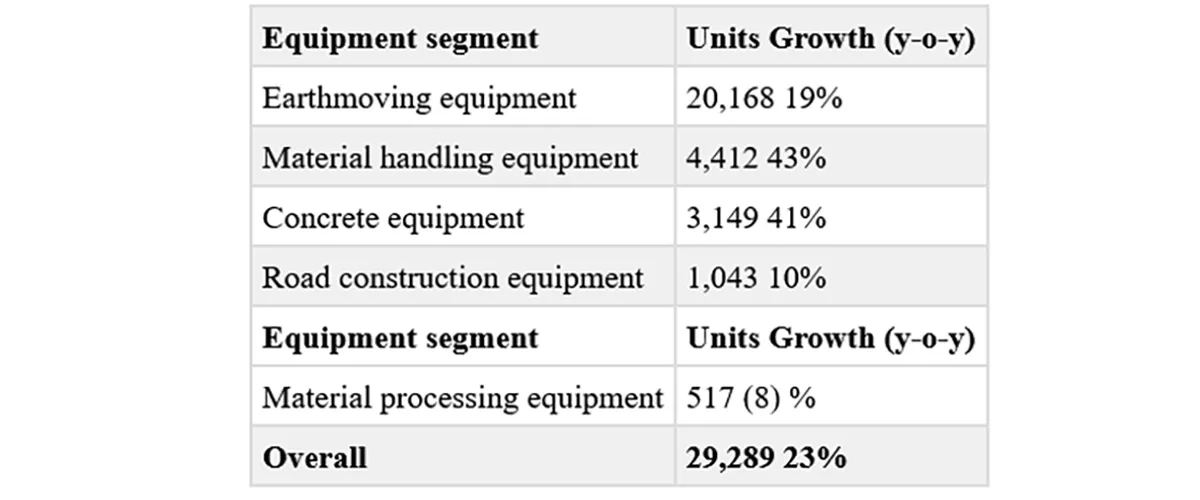
Earthmoving equipment, the largest segment, grew 19 per cent. However, the growth was driven largely by mining, particularly higher iron ore output, and by construction activity supported by State Government and private sector investment, rather than by national highways, where construction activity declined significantly. Demand from coal mining also remained subdued owing to weak project awarding. Material handling equipment grew 43 per cent as finished steel and cement consumption rose. Concrete equipment grew 41 per cent on the back of road construction activity, with bitumen consumption up by15 per cent.
Infrastructure investment: key driver of CE demand
Construction equipment demand moves directly with infrastructure creation, mining and building construction. The medium-term infrastructure investment outlook remains encouraging. Infrastructure capex is projected at ₹27.5 lakh crore in FY2026-27 and ₹29.4 lakh crore in FY2027-28, up from an estimated ₹25.2 lakh crore in FY2025-26. Investment activity is also strong across the wider economy, with gross fixed capital formation growing 11.9 per cent in Q1 FY2026-27, its fastest pace in 13 quarters.Demand outlook
The report projects that demand for construction equipment will strengthen in the second half of FY2026-27, led by the earthmoving equipment segment. This is expected to be supported mainly by the resumption of mining activity, with coal and iron ore production projected to rise, and by building and industrial construction, favourable input costs and the seasonally strong year-end construction cycle.Road-linked segments, however, are expected to remain broadly flat. Road construction equipment sales are projected at 5,000–5,500 units in FY2026-27, against 5,439 units in FY2025-26, and concrete equipment at 13,500–15,500 units, against 13,672 units. National highway construction is estimated to decline to 7,000–8,000 km in FY2026-27 and further to 6,000–7,000 km in FY2027-28, owing to fewer highway project awards in previous years.
Deepak Shetty, President, ICEMA, said: “The construction equipment industry has witnessed a strong recovery, with Q2 domestic sales growing by 23% year-on-year. The findings of the ICEMA Construction Equipment Demand Report indicate that this momentum is being supported by increased infrastructure and mining activity, as well as construction across key sectors. Continued investments in infrastructure creation and stronger project execution on the ground will be critical to sustaining this momentum through the remainder of the year. Looking ahead, we remain optimistic about the sector's prospects, driven by India's sustained focus on infrastructure development and improving demand conditions across both urban and rural markets. While geopolitical uncertainties continue to pose challenges globally, the report reinforces our confidence that the construction equipment industry will continue to play a pivotal role in supporting India's infrastructure development and economic growth ambitions.”
Ramesh Palagiri, President-Designate, ICEMA, said: “Equipment demand is closely linked to infrastructure creation. By linking infrastructure investment and key economic indicators with equipment demand, the report improves demand visibility for the industry.
Greater predictability in infrastructure investment and project awards will help manufacturers plan capacity, supply chains and investments with confidence.”