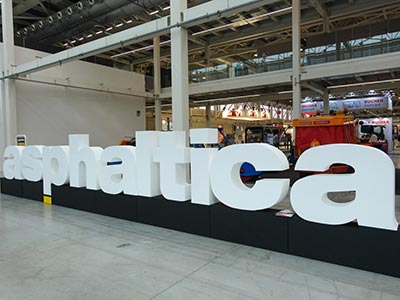
This edition was characterised by the participation of a highly qualified audience and an increasingly international outlook, as evidenced by the numerous foreign operators invited by exhibitors. Four days fostered business relations, the exchange of expertise, and dialogue among companies, network managers, professionals, research bodies, and institutions.
Hosted in the new Hall 37 of BolognaFiere, one of the exhibition district's most modern spaces, Asphaltica brought together 140 exhibitors, including 18 international exhibitors from seven countries, across a net exhibition area of 9,800 square metres. Compared to 2024, the number of exhibitors grew by 18% and the exhibition area by 34%.
"We are particularly satisfied with the results of this edition of Asphaltica, which confirms the value of the event for a sector called upon to guarantee efficient, safe, and sustainable infrastructure," stated Gianpiero Calzolari, President of BolognaFiere. "Together with SITEB, we have created an event capable of bringing together companies, institutions, professionals, and the research community around the themes that will guide the sector's evolution in the coming years. BolognaFiere confirms its role as an ideal place to foster relationships and discussions in support of production chains, bringing together expertise, investments, and innovation. The growth of Asphaltica and the wide international participation testify to the strength of a sector looking to the future and reinforce the event's value as a benchmark for the development of the entire supply chain."
"Asphaltica 2026 has confirmed itself as the home of the entire road supply chain. At the exhibition, we showcased the best that our sector has to offer. Companies, material producers, machinery and plant manufacturers, laboratories, companies involved in road safety and signage, experts, universities, and institutions found a platform to discuss and present concrete solutions for the infrastructure of the future, which is becoming increasingly intelligent, sustainable, and durable," stated Raffaella Donghi, President of SITEB. "The continuous growth of the event demonstrates that roads represent a strategic priority for our country and that the sector has the skills, technologies, and vision to face the challenges ahead. The Sustainable Construction Site (Il Cantiere Sostenibile), over 40 conferences and workshops, and our Agorà sessions on the most topical issues for the sector highlighted a supply chain that invests in safety, innovation, the circular economy, and low-impact technologies, with a special focus on young people and generational renewal in a sector called upon to play an increasingly central role."
The SITEB Agorà focused discussions on the most topical issues for the sector, starting with the General States of Road Construction (Stati Generali delle Costruzioni Stradali), dedicated to the sector's prospects, investments, and network maintenance, with the participation of, among others, ANAS Chief Executive Officer Claudio Andrea Gemme.
The discussions continued with meetings on safety, including the use of robotic dogs, and the evolution towards Smart Roads, with contributions from senior management at Autostrade dello Stato. Other discussions focused on sustainability and ESG criteria, ranging from material innovation to skills development.
These events were complemented by over 40 conferences and workshops held during the exhibition, offering opportunities for technical insights, updates, and training. Topics also included the life cycle assessment of pavements, the durability of works, and the application of CAM Strade (Minimum Environmental Criteria for Roads).
Highlighting the European dimension of the event, EAPA (the European Asphalt Pavement Association) chose Asphaltica for its autumn Technical Committee meeting for the first time, bringing together experts from across Europe.
The Sustainable Construction Site (Cantiere Sostenibile), created in collaboration with InFrastrade, was a major success. It showcased the various phases of road regeneration using the latest-generation machinery. From subgrade stabilisation to the simulation of asphalt laying with a high content of recycled milled material, the demonstrations brought the application of circular economy principles and Minimum Environmental Criteria to life, illustrating solutions for recovering materials, reducing environmental impacts, and improving the efficiency of interventions.
Visitors were also able to appreciate an exhibition of historic ANAS vehicles and equipment, organised to mark the 80th anniversary of its foundation. It offered a journey through the evolution of Italian road construction and maintenance, combining a vision of the future with the technical heritage of the sector.
Asphaltica 2026 has outlined the profile of a supply chain that invests in innovation, sustainability, and skills, leveraging the opportunities offered by digitalisation and smart infrastructure to improve safety and the management of road assets. The growth recorded consolidates the event's position and strengthens its identity within the international trade fair landscape dedicated to infrastructure systems.
The journey continues with Asphaltica World, scheduled for October 20 and 21, 2027, at the Salone delle Fontane in Rome. The exhibition-conference format will provide a platform to address the sector's major challenges and facilitate dialogue with the political and institutional world, fostering interaction between industry stakeholders and central institutions.
In 2028, Asphaltica will return to Bologna in its full trade fair format.