
Executive Summary
The 2026 Venezuela Earthquake Doublet, comprising a Mw 7.2 foreshock followed 39 seconds later by a Mw 7.5 mainshock, was one of the most destructive earthquakes in the country's recent history. The prolonged ground shaking caused widespread building collapses, severe infrastructure damage, and a major humanitarian crisis, particularly in La Guaira State, highlighting the vulnerability of ageing and inadequately detailed building stock.This report examines the engineering causes of the widespread structural failures and demonstrates that the devastation was not solely due to the earthquake magnitude, but also to poor seismic detailing, non-ductile reinforced concrete construction, soft-storey configurations, structural irregularities, inadequate construction quality, and adverse geotechnical conditions such as soft soils and liquefaction.
The report further highlights that while all structural systems can perform satisfactorily when properly designed and constructed, structural steel and steel–concrete composite framing systems generally offer superior seismic performance because of their higher ductility, lower self-weight, greater energy dissipation capacity, and inherent redundancy. These advantages, however, can only be realised through sound planning, quality materials, proper detailing, competent construction practices, and rigorous engineering supervision.
Based on the lessons from the Venezuela earthquake, the report recommends strengthening seismic design practices, improving construction quality, adopting steel-intensive structural systems wherever feasible in seismic regions, enforcing building codes, and undertaking periodic assessment and retrofitting of vulnerable existing buildings to enhance the resilience of the built environment.
Introduction
On 24 June 2026, two devastating strike-slip earthquakes—a Mw 7.2 foreshock followed 39 seconds later by a Mw 7.5 mainshock—struck northwestern and central Venezuela in an event known as an earthquake doublet. The epicentres of both earthquakes were located in Veroes Municipality, Yaracuy State, approximately 160 km west of Caracas.This was the strongest earthquake in Venezuela since the 1900 San Narciso earthquake (Mw 7.7) and has caused one of the most devastating humanitarian disasters in the country's modern history. La Guaira State, where approximately 80% of surveyed buildings either collapsed or sustained severe structural damage, was declared a disaster zone. As of July 2026, official reports indicate more than 4,500 fatalities, 16,700 injuries, and thousands of people still missing. — with independent observers and UN modelling suggesting the true death toll may exceed 10,000.
Scale at a Glance (as of 11 July 2026 — figures continue to rise)
Confirmed dead: 4,500+ | Injured: 16,700+ | Buildings damaged/ destroyed: Approximately 590,000 | People needing relief: up to 6.8 million | Direct economic damage: USD 6.7 billion (~6% of GDP) | UNDRR total infrastructure damage estimate: USD 37 billion | Aftershocks recorded: 860+
The Earthquake Event
What is an Earthquake Doublet?
In a doublet, the first earthquake relieves stress on one fault segment while simultaneously loading an adjacent fault closer to its failure threshold. The added stress triggers the second rupture within seconds. The result is back-to-back major earthquakes with almost no time between them, producing prolonged ground shaking far more destructive than either event would produce alone.Key parameters of the doublet:
- Foreshock: Mw 7.2 at 18:04 VET — depth 20.3 km, approximately 23 km southeast of Yumare
- Mainshock: Mw 7.5 at 18:04:39 VET (39 seconds later) —focal depth approximately 10 km, with an epicentre approximately 28 km southeast of Yumare.
- Aftershocks: More than 860 aftershocks were recorded following the mainshock, including a Mw 5.5 event on 26 June that caused the collapse of a critical bridge connecting Caraballeda to the rest of La Guaira, significantly hampering rescue operations.
Previous seismic activity
The region has a long history of damaging seismic events. Within approximately 250 km of the 2026 epicentral area, at least seven earthquakes of magnitude 6.0 or greater have occurred during the past century. Among these, the 1967 Caracas earthquake (Mw 6.5) was particularly significant, causing more than 200 fatalities and leading to Venezuela's first major revision of its seismic design code. However, enforcement and implementation of these seismic provisions remained inconsistent for several decades, contributing to the vulnerability of much of the existing building stock.More recently, the same region experienced a Mw 5.5 earthquake in September 2025, followed by a Mw 6.2–6.3 earthquake doublet that injured approximately 110 people. These events highlighted the high seismic potential of the regional fault system and underscored the continued seismic hazard prior to the June 2026 earthquake sequence.
Tectonic Setting
Northern Venezuela is situated along the active plate boundary between the Caribbean Plate and the South American Plate, where the two plates move past each other while also pushing against one another. This interaction generates significant crustal stresses, making northern Venezuela one of the most seismically active regions in the Western Hemisphere.The dominant tectonic feature controlling regional seismicity is the Boconó–Morón–El Pilar fault system, a major right-lateral strike-slip fault network extending approximately 1,300 km across northern Venezuela. Continuous relative motion between the Caribbean and South American plates results in the accumulation of strain along these faults, which is periodically released through moderate to large earthquakes.
Scale of Damage
The earthquake doublet occurred during the Battle of Carabobo national holiday, when a large proportion of the population was at home rather than at workplaces or educational institutions. Consequently, the collapse of residential buildings resulted in exceptionally high casualties. Damage was widespread across La Guaira, Caracas (Distrito Capital), Miranda, Carabobo, Aragua, Yaracuy, and Trujillo, with La Guaira State experiencing the most severe destruction.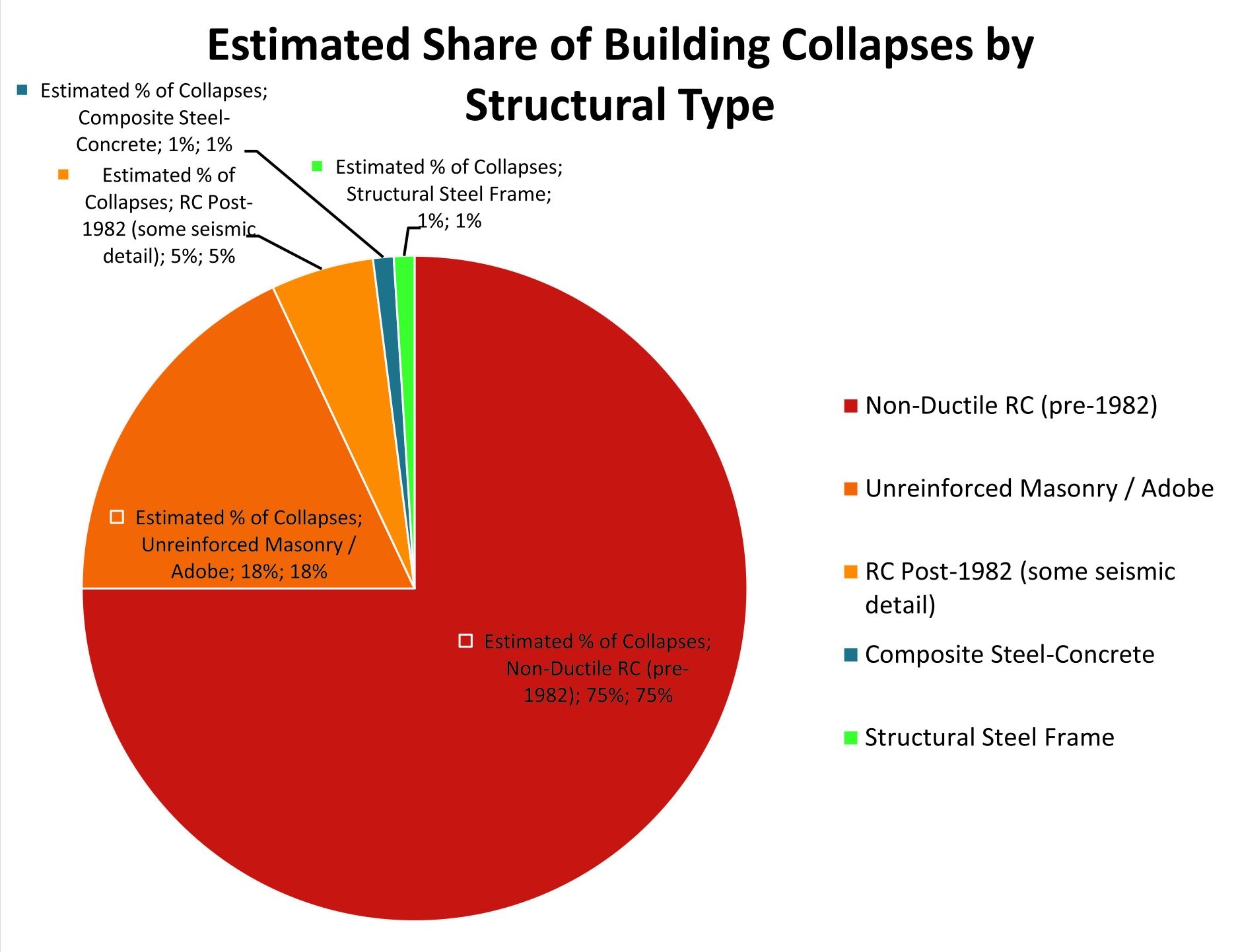
The overall impact extended well beyond building collapse, affecting transportation infrastructure, public services, and humanitarian response. Large-scale structural failures, displacement of residents, and disruption of critical facilities significantly complicated rescue and relief operations.
Engineering Analysis of Building Collapses
The widespread building collapses during the 2026 Venezuela earthquake sequence cannot be attributed to earthquake magnitude alone. Rather, they resulted from the combined effects of unfavourable seismological conditions, local geotechnical characteristics, and vulnerabilities in the existing building stock.Seismological Factors
- Successive strong ground motions: The earthquake doublet subjected buildings to two episodes of strong shaking within 39 seconds. Structures already weakened by the foreshock experienced the stronger mainshock before damage could be stabilized, leading to cumulative structural deterioration and an increased probability of collapse.
- High ground-motion intensity: Owing to the shallow source and large earthquake magnitude, the affected region experienced severe ground shaking. According to the USGS ShakeMap, peak shaking reached Modified Mercalli Intensity (MMI) IX near the epicentral region, an intensity capable of causing severe damage or collapse in non-ductile structures.
- Forward rupture directivity: The rupture propagated eastward toward the densely populated corridor of La Guaira and Caracas, producing a forward directivity effect. This concentrated seismic energy into a strong velocity pulse, increasing ground-motion intensity and structural demand in the direction of rupture.
Geotechnical Amplification
- Sedimentary basin amplification: Caracas is situated within a deep sedimentary basin where soft alluvial deposits amplified seismic waves and increased the duration of ground shaking. The resulting ground-motion characteristics closely matched the natural vibration periods of many 5–15 storey buildings, increasing the likelihood of resonance, and consequently the seismic forces acting on these structures.
- Soft soil and liquefaction: Coastal areas, particularly La Guaira, are underlain by soft, water-saturated alluvial soils and reclaimed land. Under strong earthquake shaking, these soils are susceptible to liquefaction, a phenomenon in which saturated soils temporarily lose strength and stiffness. This can lead to foundation settlement, tilting of buildings, lateral ground movement, and damage to roads, bridges, and buried utilities. Assessments by Arup indicated that liquefaction and localized landslides likely contributed to the observed damage in coastal and hillside areas.
- Comparison with previous earthquakes: Similar site amplification effects have been observed in other major earthquakes, most notably the 1985 Mexico City earthquake, where soft lake-bed sediments significantly amplified ground motions despite the earthquake occurring at a considerable distance from the city. This comparison highlights the critical influence of local soil conditions on earthquake damage.
The Pancake Collapse: Non-Ductile Concrete Construction
One of the most striking structural failures observed during the earthquake was the pancake collapse of reinforced concrete buildings, in which successive floor slabs collapsed vertically onto one another following the failure of critical supporting columns. This is among the most severe forms of earthquake-induced structural failure because it develops rapidly, provides little opportunity for evacuation, and significantly reduces survivable void spaces for trapped occupants.What Causes Pancake Collapse?
In a well-engineered concrete column, closely spaced steel 'tie' bars (stirrups or hoops) confine the concrete core. When the column is overstressed, the ties hold the reinforcing bars in place, allowing the column to bend and absorb energy — ductile behaviour. In older or poorly built columns, ties are widely spaced or missing. When overstressed, the concrete explodes outward, the core loses confinement, and the column gives way instantly. If one or more critical load-bearing columns lose their load-carrying capacity, the floors they support can drop onto the storeys below propagating all the way to the ground in seconds. This brittle, non-ductile failure mechanism was a major contributor to building collapses in Turkey (2023), Haiti (2010), Iran (2003), and now Venezuela (2026).
Engineering Assessment
- Inadequate column confinement: Many collapsed buildings exhibited insufficient transverse reinforcement in columns, resulting in brittle shear failure instead of the ductile flexural behaviour required for earthquake-resistant design.
- Soft-storey mechanism: Buildings with open ground floors used for parking or commercial spaces, lacked adequate lateral stiffness and strength at the ground level. Concentration of seismic deformation in this storey led to column failure and subsequent collapse of the upper floors.
- Pre-code construction: A significant proportion of the collapsed buildings were constructed before the introduction of Venezuela's first modern seismic design code and therefore lacked modern seismic detailing requirements.
- Construction quality: Rapid post-disaster housing development following the 1999 Vargas landslides is reported to have produced buildings with inadequate seismic detailing and construction quality, particularly in La Guaira, increasing their vulnerability during the 2026 earthquake.
- Structural irregularities: Buildings with irregular floor plans, setbacks, or abrupt changes in stiffness experienced torsional response and uneven force distribution, increasing demands on individual structural members.
- Masonry infill interaction: Unreinforced masonry infill walls altered the stiffness distribution of reinforced concrete frames and, in some cases, created short-column effects that increased the likelihood of brittle column failure.
- Pounding between adjacent buildings: Closely spaced buildings with different heights and dynamic characteristics collided during strong shaking, causing localized structural damage and, in some cases, contributing to progressive collapse.
Deformation Pattern Under Seismic Forces
During an earthquake, buildings are subjected to horizontal inertial forces generated by the acceleration of their mass. These lateral forces increase with building height, causing each floor to move relative to the floor below. The resulting deformation is resisted by the building's lateral load-resisting system, such as shear walls, braced frames, or moment-resisting frames.Inter-Storey Drift — Why It Matters
The relative horizontal displacement between two consecutive floors is known as inter-storey drift. Excessive drift increases structural and non-structural damage by imposing large deformations on columns, beams, walls, and connections. Seismic design codes specify permissible drift limits to ensure acceptable structural performance during earthquakes. Buildings with inadequate lateral stiffness or ductility experience excessive concentration of drift in one or more storeys, resulting in severe structural damage and, in extreme cases, progressive collapse. Effective seismic design therefore requires an appropriate balance of strength, stiffness, and ductility to control deformation while safely dissipating earthquake energy.
Material Choice and Construction Quality in Seismic Design
A key lesson from major earthquakes is that seismic safety cannot be attributed to the choice of structural material alone. Structural steel, steel–concrete composite, reinforced concrete (RC) systems, and reinforced masonry can all provide satisfactory seismic performance when properly designed, detailed, and constructed. Conversely, deficiencies in structural design, material quality, connections, detailing, workmanship, or construction supervision can significantly compromise the performance of any structural system.Key Principle: Poor Construction Negates Material Advantage
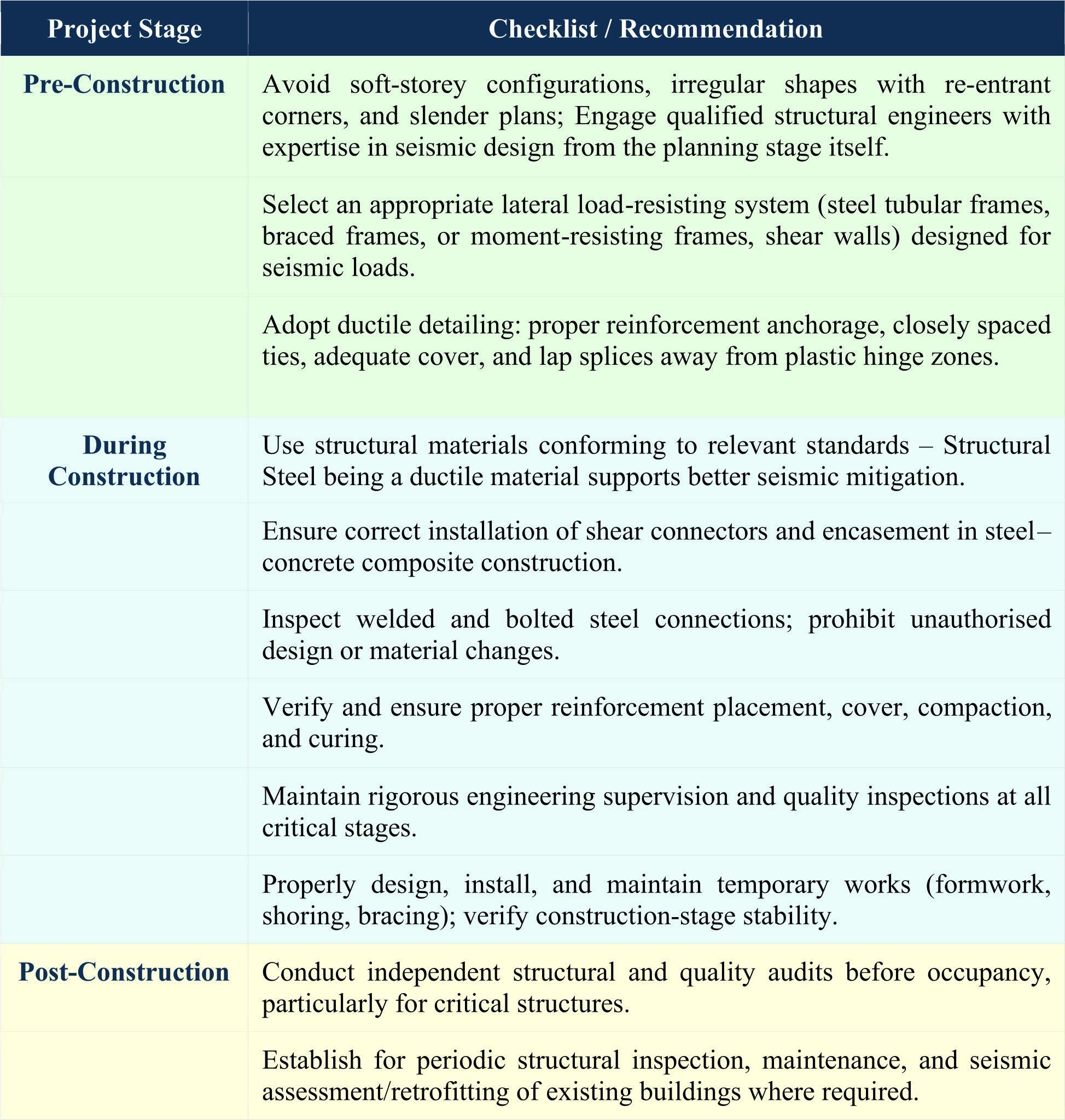
Even the most ductile structural steel frame will collapse if: welds are defective or absent; bolted connections are under-designed; bracing members are omitted to save cost; steel sections are thinner than specified; or erection is carried out without engineering supervision. The 1994 Northridge and 1995 Kobe earthquakes both exposed brittle fracture failures in steel moment connections that were assumed to be inherently safe — demonstrating that the material's potential is only realised when design, fabrication, and construction quality are all controlled. Material choice sets the ceiling; execution determines the outcome.
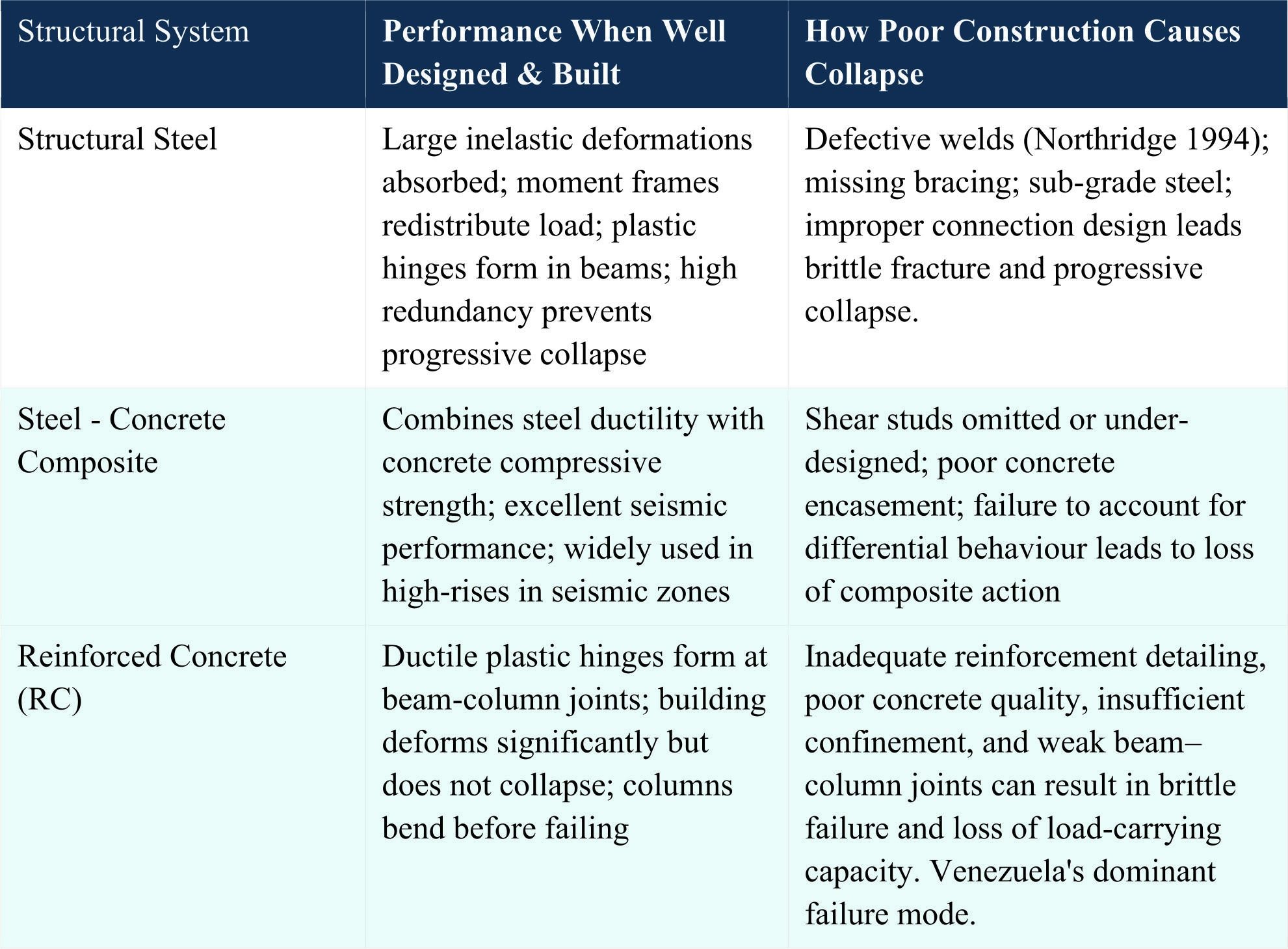
Although no structural material is inherently earthquake-proof, structural steel and steel–concrete composite framing systems generally provide superior seismic performance compared with conventional reinforced concrete framing because of their higher ductility, favourable strength-to-weight ratio, greater energy dissipation capacity, redundancy, and ability to undergo large inelastic deformations without sudden loss of strength. Consequently, in earthquake-prone regions, steel and composite framed buildings can achieve greater resilience and reduced seismic damage than conventional RC framed buildings, provided that structural planning, seismic design, material quality, fabrication, construction practices, and quality control are carried out in accordance with applicable standards.
Lessons for Earthquake-Resistant Design and Construction
The 2026 Venezuela earthquake sequence highlights challenges that extend beyond the affected region. Many earthquake-prone areas worldwide face similar conditions, including ageing and non-ductile building stock, inadequate enforcement of seismic codes, variable construction quality, and limited investment in seismic assessment and retrofitting. Reducing future earthquake losses therefore requires coordinated measures across structural design, construction quality, existing building retrofit, and regulatory enforcement.When planning, design, material procurement, and construction practices all meet the required standards, steel-framed and steel-concrete composite-framed structures provide demonstrably better seismic response mitigation than equivalent RC-framed structures. Their inherent material ductility allows large inelastic deformations without sudden failure; plastic hinges form in beams rather than columns, dissipating earthquake energy progressively; redundant load paths prevent progressive collapse; and connections can be fabricated, tested, and certified to a precision that cast-in-situ concrete cannot match. For buildings in high seismic zones, this translates into a meaningful difference in the probability of collapse — and in occupant survival — during a major earthquake event. Adoption of steel-intensive structures wherever feasible, particularly for public buildings, hospitals, schools, and high-occupancy residential blocks in seismic zones, is therefore recommended.