Balancing Decarbonization and Durability for Sustainable Infrastructure
As the cement industry intensifies its drive to cut carbon emissions, an equally critical question arises: how can decarbonization strategies be balanced with the long-term durability of infrastructure? In this article, Dr S B Hegde explores the complex relationship between low-carbon cement technologies and concrete performance, highlighting why sustainability must be evaluated not only by emissions per ton of cement, but also by the ability to deliver durable, long-lasting infrastructure with lower lifecycle carbon.

Abstract
Premature deterioration of infrastructure can offset environmental benefits by increasing lifecycle emissions due to repair and reconstruction. This paper examines the scientific balance required between cement decarbonization and concrete durability.
Key mechanisms affecting durability in modern binder systems—including pore solution chemistry, carbonation kinetics, SCM variability, clinker microstructure and trace element effects—are analyzed. The concept of Strength Efficiency of Clinker (SEC) is introduced to link clinker utilization with structural performance.
The study proposes that sustainability should be evaluated not only by CO2 per ton of cement, but also by CO2 per unit of durable infrastructure delivered. Achieving this balance will require integrated research, improved manufacturing practices and performance-based design approaches.
Introduction
Cement is the most widely used construction material after water and forms the foundation of modern infrastructure development. According to the Global Cement and Concrete Association, global cement production reached approximately 4.1 billion tonnes in 2023. The primary source of carbon emissions in cement production is clinker manufacturing. During calcination, limestone decomposes according to the reaction: CaCO3→CaO+CO2. This reaction alone releases approximately 0.53 tonnes of CO2 per tonne of clinker. Including fuel combustion and electricity consumption, total emissions typically reach 0.80–0.90 tonnes CO2 per tonne of clinker.Given these numbers, reducing clinker consumption is considered the most effective pathway for reducing cement-related emissions. However, sustainability must be assessed not only at the production stage but also over the entire lifecycle of infrastructure constructed using cement-based materials. Infrastructure such as bridges, highways, marine structures and high-rise buildings are typically designed for service lives of 50–100 years.
If durability is compromised, early repair or reconstruction may significantly increase lifecycle emissions. Therefore, the transition toward low-carbon cement systems must maintain a careful balance between emission reduction and infrastructure longevity.
Global Decarbonization Strategies in Cement Manufacturing
Decarbonization of cement production relies on several technological approaches.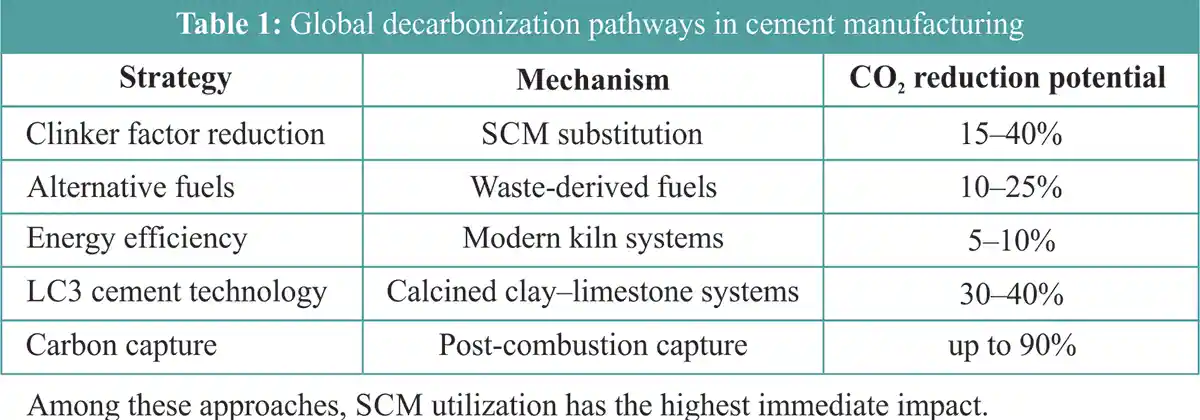
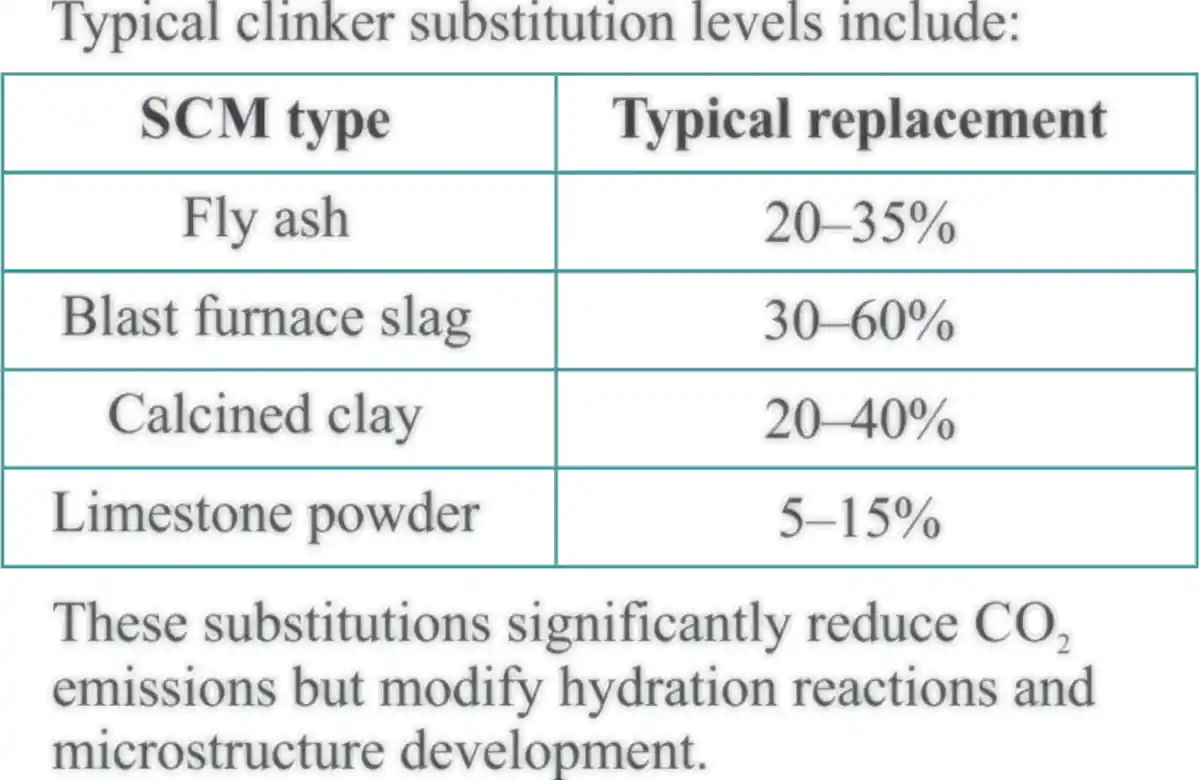
These substitutions significantly reduce CO2 emissions but modify hydration reactions and microstructure development.
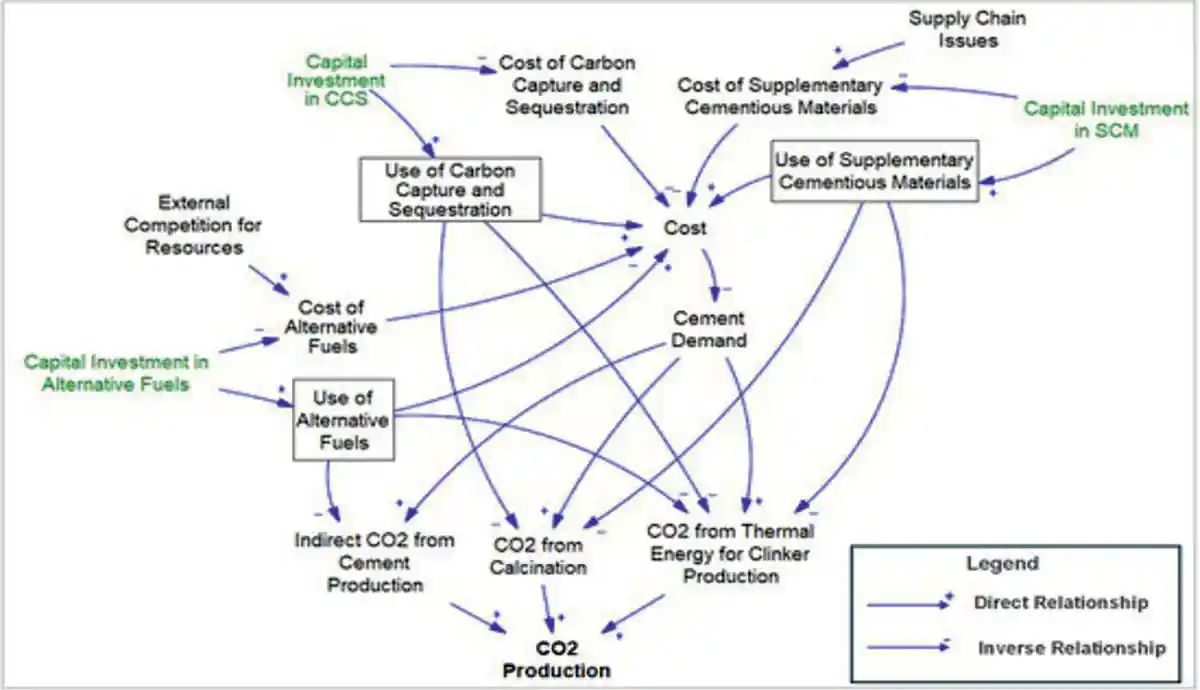
Figure 1: Decarbonization Pathways in Cement Manufacturing
Hydration Chemistry of Low-Clinker Cement Systems
The hydration of Portland cement is primarily governed by reactions of tricalcium silicate (C3S) and dicalcium silicate (C3S) .2C3S + 6H → C3S2H3 + 3CH
2C2S + 4H → C3S2H3 + CH
where:
C3S2H3 = Calcium silicate hydrate (C-S-H)
CH = Calcium hydroxide.
C-S-H is responsible for most of the strength in hardened cement paste.
In blended cement systems, SCMs participate in pozzolanic reactions:
CH + S + H → C−S−H
where S represents reactive silica.
These reactions consume calcium hydroxide and produce additional C-S-H gel, improving pore structure density but reducing available alkalinity.
Carbonation Kinetics and Durability
Carbonation occurs when atmospheric CO2 reacts with calcium compounds in concrete:Ca (OH)2 + CO2 → CaCO3 + H2O
Carbonation depth is commonly modeled using:
x = k sq roof of t
Where,
x = carbonation depth
k = carbonation coefficient
t = time.
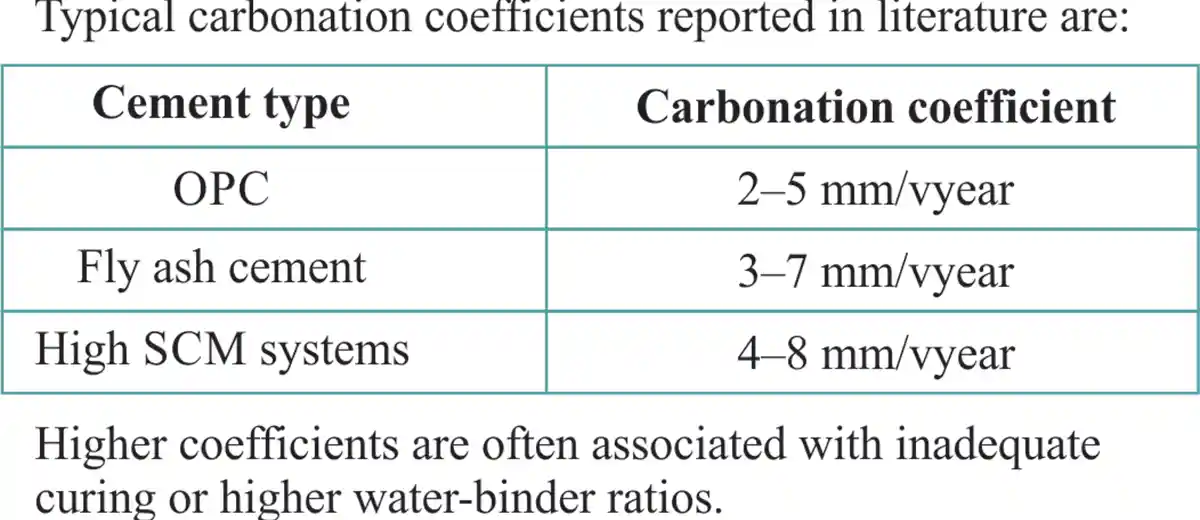
Hidden Durability Factors in Modern Binder Systems
Several subtle factors influence durability in low-clinker cement systems.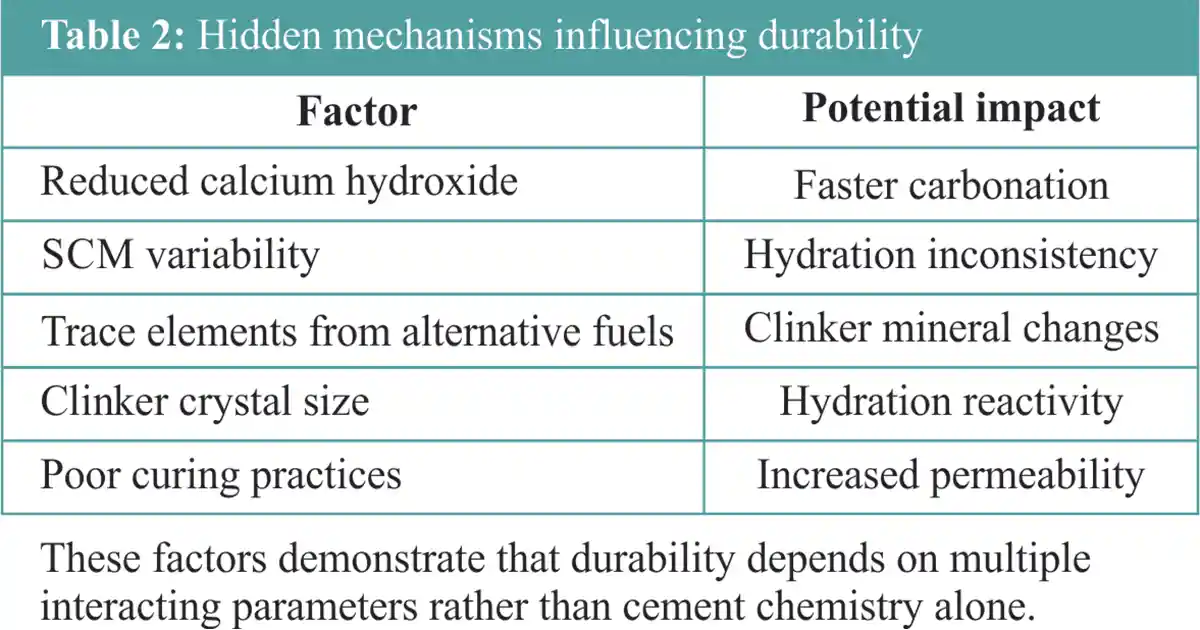
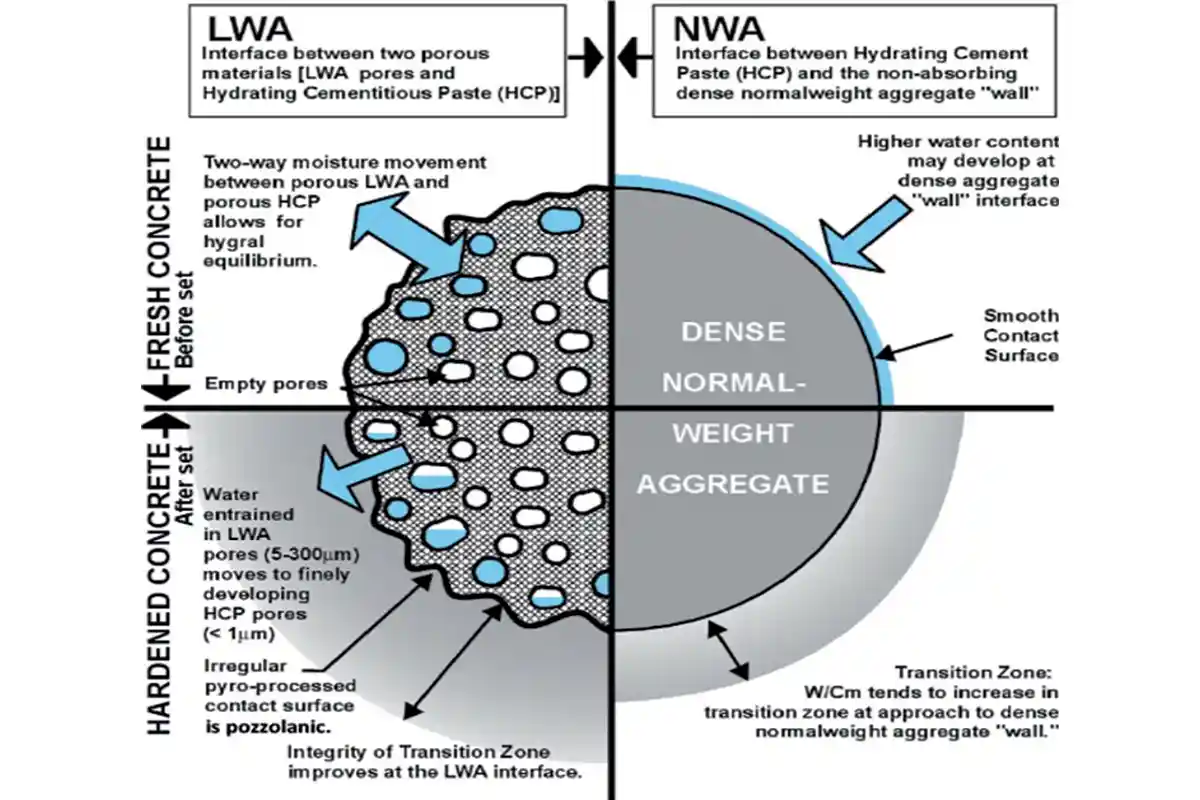
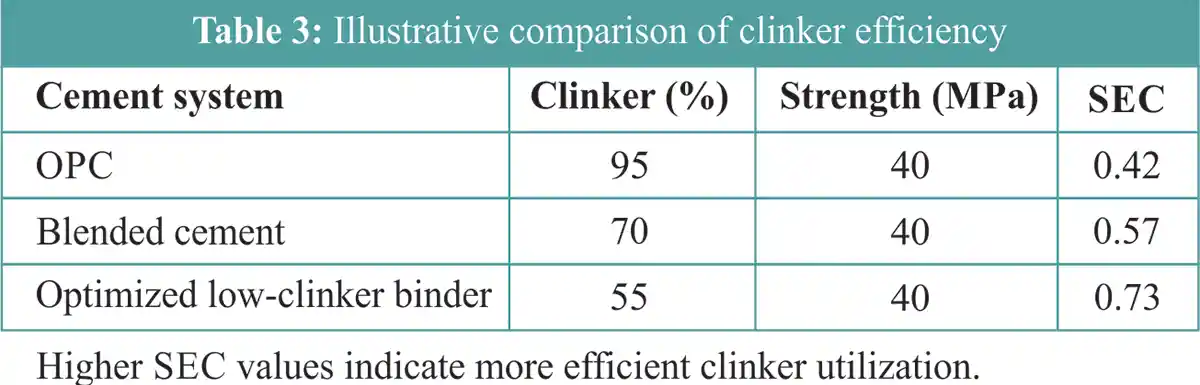
Strength Efficiency of Clinker
Traditional cement industry metrics measure energy and emissions per ton of cement. However, structural performance depends on how efficiently clinkers contribute to concrete strength.The Strength Efficiency of Clinker (SEC) can be expressed as: SEC= fc/C
Where,
(fc) = compressive strength of concrete
(C) = clinker content.
Lifecycle Carbon Implications
Lifecycle assessment studies indicate that premature infrastructure deterioration can significantly increase carbon emissions.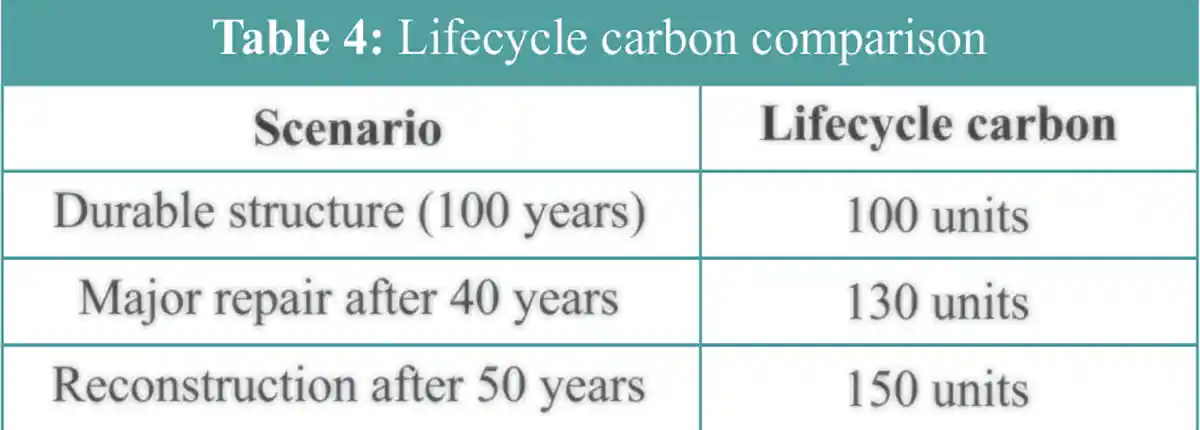
This demonstrates that durability improvements can act as a carbon reduction multiplier.
Manufacturing Implications for Cement Plants
Future cement manufacturing may require broader quality control strategies beyond traditional parameters such as LSF, SM, and AM. Additional monitoring parameters may include:- clinker crystal size distribution
- trace element concentration from alternative fuels
- SCM reactivity index
- hydration kinetics
Implications for Structural Design
Current concrete design codes often rely primarily on compressive strength as a performance indicator. However, durability is more strongly influenced by transport properties such as permeability and diffusion.Future design frameworks may incorporate parameters including:
- Chloride diffusion coefficient
- Carbonation resistance
- Permeability index
- Pore structure refinement.
Toward a New Sustainability Metric
Current sustainability evaluations focus on CO2 emissions per ton of cement. However, a more meaningful metric may be:CO2 per unit of durable infrastructure delivered
This metric integrates cement production emissions with infrastructure service life and durability performance.
Future Vision for Sustainable Cement Systems
The next generation of cement technologies will likely focus on optimizing the relationship between:- Clinker chemistry
- SCM reactivity
- Hydration microstructure
- Infrastructure durability.
Future Research Directions and Implementation Roadmap
The concept of evaluating sustainability based on CO2 per unit of durable infrastructure delivered requires further scientific investigation as well as practical implementation across the cement and construction industries. Several research areas deserve focused attention in the coming years.Long-Term Pore Solution Chemistry: In low-clinker cement systems, the reduction of calcium hydroxide due to SCM reactions may influence the alkalinity of pore solutions. Long-term monitoring of pore solution pH evolution over decades is essential to better understand reinforcement protection in modern binder systems. Advanced techniques such as pore solution extraction, electrochemical monitoring, and thermodynamic modelling can help clarify these mechanisms.
Carbonation Behavior of Low-Carbon Cement Systems: Carbonation resistance is becoming increasingly important in low-clinker cement systems. Future research should focus on improving predictive models for carbonation depth by incorporating parameters such as pore structure, curing conditions, and environmental exposure. Development of improved carbonation models will help engineers design structures with longer service lives.
Standardization of SCM Reactivity: One of the major challenges in modern cement systems is the variability in SCM properties. Differences in mineral composition, glass content and fineness can influence hydration behavior. Future research should focus on developing standardized reactivity indices and quality control methods for SCMs to ensure consistent performance.
Influence of Alternative Fuels on Clinker Chemistry: The growing use of alternative fuels introduces trace elements into clinker. The long-term influence of these elements on hydrated behavior and durability is still not fully understood. Detailed studies on trace element incorporation in clinker phases and their influence on hydration kinetics will help cement plants maintain product quality while increasing fuel substitution.
Development of Durability-Based Performance Metrics: Traditional cement quality control primarily focuses on compressive strength. However, durability depends on several additional parameters such as permeability, carbonation resistance, and chloride diffusion. Future research should focus on developing durability-based performance indices that can be integrated into cement standards and structural design codes.
Digital and AI-Based Predictive Models: Recent advances in artificial intelligence and digital process control offer new opportunities for predicting cement and concrete performance. Machine learning models can analyze large datasets from cement plants and construction projects to predict durability performance based on cement chemistry, curing conditions and environmental exposure. Such digital tools could significantly improve the design of low-carbon cement systems.
Pathway for Industry Implementation
For effective implementation of the proposed sustainability concept, collaboration between multiple stakeholders will be essential.Cement Industry: Cement plants should expand quality control systems beyond traditional chemical parameters to include clinker microstructure, SCM reactivity and hydration kinetics.
Concrete Industry: Concrete mix designs should consider durability parameters such as permeability, carbonation resistance and curing conditions, especially when using high SCM contents.
Infrastructure Designers: Structural design codes should gradually move toward performance-based durability specifications rather than relying solely on compressive strength.
Research Institutions: Universities and research laboratories should undertake interdisciplinary research linking cement chemistry, concrete durability and infrastructure lifecycle performance.
Final Strategic Message: The next generation of sustainable cement systems will not be defined only by how little CO2 is emitted during production, but by how effectively cement contributes to long-lasting and resilient infrastructure.
Achieving this balance between decarbonization and durability will define the future of the cement and construction industries.
Conclusion
Reducing carbon emissions from cement production is essential for addressing global climate challenges. Strategies such as clinker factor reduction, increased use of supplementary cementitious materials, alternative fuels and improved process efficiency are already lowering CO2 emissions per ton of cement.However, true sustainability must also consider the long-term durability of infrastructure. If structures deteriorate prematurely and require repair or reconstruction, the resulting lifecycle emissions may offset the benefits of decarbonization.
This study highlights the need to balance decarbonization with durability, emphasizing the influence of pore solution chemistry, carbonation behavior, SCM variability, clinker microstructure and curing conditions on long-term performance.
The concept of Strength Efficiency of Clinker (SEC) offers a useful perspective for improving clinker utilization while maintaining structural reliability.
Ultimately, sustainability should be evaluated not only by CO2 per ton of cement, but by CO2 per unit of durable infrastructure delivered.
References
- Bertolini, L., Elsener, B., Pedeferri, P., Polder, R., 2013. Corrosion of Steel in Concrete: Prevention, Diagnosis, Repair. Wiley, New York.
- Damtoft, J., Lukasik, J., Herfort, D., Sorrentino, D., Gartner, E., 2008. Sustainable development and climate change initiatives in the cement industry. Cement and Concrete Research, 38(2), 115–127.
- Gartner, E., Sui, T., 2018. Alternative cement clinkers. Cement and Concrete Research, 114, 27–39.
- Global Cement and Concrete Association, 2023. Concrete Future: The GCCA Net Zero Roadmap. London.
- Habert, G., Miller, S., John, V., Provis, J., Favier, A., Horvath, A., Scrivener, K., 2020. Environmental impacts and decarbonization strategies in the cement and concrete industries. Nature Reviews Earth & Environment, 1, 559–573.
- Juenger, M., Snellings, R., Bernal, S., 2019. Supplementary cementitious materials: New sources, characterization, and performance insights. Cement and Concrete Research, 122, 257–273.
- Mehta, P.K., Monteiro, P.J.M., 2014. Concrete: Microstructure, Properties and Materials. McGraw-Hill Education.
- Neville, A.M., 2011. Properties of Concrete. Pearson Education Limited.
- Papadakis, V.G., Vayenas, C.G., Fardis, M.N., 1991. Fundamental modeling and experimental investigation of concrete carbonation. ACI Materials Journal, 88(4), 363–373.
- Provis, J.L., 2018. Alkali-activated materials. Cement and Concrete Research, 114, 40–48.
- Scrivener, K., John, V., Gartner, E., 2018. Eco-efficient cements: Potential economically viable solutions for a low-CO2 cement-based materials industry. Cement and Concrete Research, 114, 2–26.
- Scrivener, K., Martirena, F., Bishnoi, S., Maity, S., 2018. Calcined clay limestone cement (LC3). Cement and Concrete Research, 114, 49–56.
- Snellings, R., Mertens, G., Elsen, J., 2012. Supplementary cementitious materials. Reviews in Mineralogy and Geochemistry, 74, 211–278.
- Taylor, H.F.W., 1997. Cement Chemistry. Thomas Telford Publishing.
- Thomas, M., 2013. Supplementary Cementing Materials in Concrete. CRC Press.
- World Cement Association, 2022. Cement Industry Net Zero Strategy. London.
- International Energy Agency, 2023. Cement Technology Roadmap: Low-Carbon Transition in the Cement Industry.
- Benhelal, E., Zahedi, G., Shamsaei, E., Bahadori, A., 2013. Global strategies and potentials to curb CO2 emissions in cement industry. Journal of Cleaner Production, 51, 142–161.