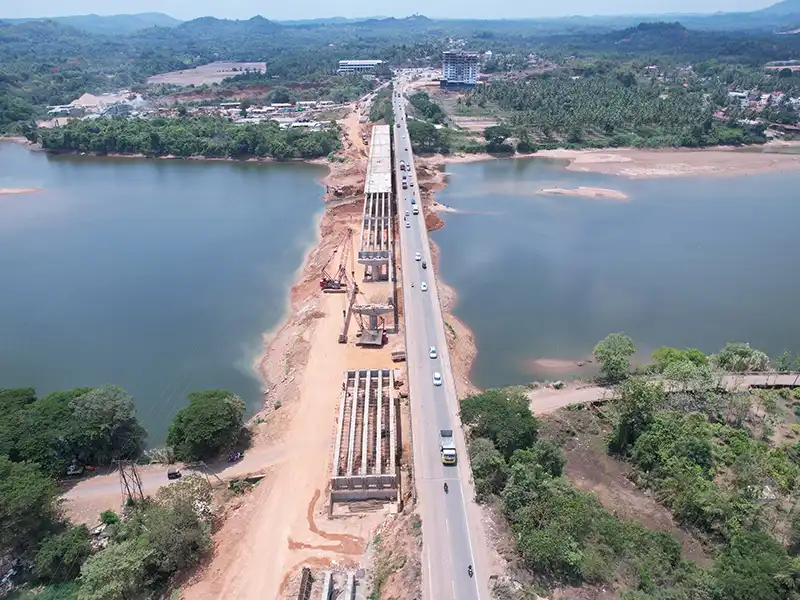
Contractors who secure projects with unrealistically low bids may struggle to deliver within budget and timelines. This often results in repeated requests for contract variations, deadline extensions, or in severe cases, project abandonment.
Nagesh Veeturi
Executive Director – Civil
KEC International
National Council Member, Construction Federation of India (CFI)

L- 1 Incentivizing a ‘Race to the Bottom’
India’s infrastructure development is at a pivotal juncture, and the procurement model adopted for public projects plays a decisive role in shaping their quality, efficiency, and long-term value. The traditional L1 bidding system, where contracts are awarded to the lowest financial bidder, has come under increasing scrutiny for its adverse impact on both infrastructure quality and project delivery. The model often incentivizes a "race to the bottom," with contractors compromising on material standards and construction practices to meet unrealistically low bid values. This results in infrastructure that lacks durability and demands frequent maintenance, undermining the return on investment.Reliance on basic pass-fail criteria for technical qualifications often overlooks highly experienced and capable firms in favor of the lowest price, regardless of their ability to manage complex projects. Timely execution is another casualty of the L1 approach, with abnormally low bids being financially unviable, leading to delays, excessive contract variations, or even project abandonment.
Adaptive Strategies Amid Challenges
Given the inherent issues in the L1 system, such as compromised quality, unrealistic bids, and project delays, leading contractors are adopting adaptive strategies to deliver high-quality outcomes despite these constraints.Strategic tender selection through risk profiling helps contractors pursue opportunities where they hold a clear advantage, avoiding projects with unclear specifications or clients with a history of disputes. Lean bidding practices embed mechanisms to recover costs through well-documented claims for variations. Lean construction methodologies minimize waste, optimize supply chains, and enhance on-site productivity, allowing projects to be delivered at lower actual costs without compromising quality. Investments in advanced machinery reduce reliance on manual labour, improving speed, precision, and build quality.
Contractors also prioritize reliable partners and suppliers to maintain consistent performance, while a strong focus on safety enhances productivity and minimizes delays. Rigorous in-house quality assurance systems, including checks on raw materials and continuous supervision, ensure that winning an L1 contract does not equate to compromising on quality.

Making the Shift from Cost Minimization to Value Maximization
To address the challenges of conventional low-cost bidding, the Quality-cum-Cost Based Selection (QCBS) model is gaining traction, assessing bids through a weighted combination of technical merit and financial offer. Life-Cycle Cost Analysis (LCCA) further strengthens decision-making by factoring in total ownership costs, including maintenance and eventual decommissioning. Prioritizing proven performance and thorough technical evaluation ensures that only capable firms secure contracts, reducing risks tied to unrealistic low bids.Beyond bid evaluation, systemic reforms are essential for sustainable infrastructure growth. Transparent, publicly accessible bid openings, balanced-standardized tender documentation, and independent audits of Detailed Project Reports (DPRs) enhance fairness and reliability. Equitable risk allocation and performance-based incentives, such as rewards for early completion, superior quality, and innovative solutions, shift the focus from cost minimization to value maximization. Specialized approaches like the Fixed-Price, Highest Technical Score (T1) model, which awards contracts based solely on technical excellence, further promote accurate and actionable DPRs.
DPRs vs. Ground Reality
Despite their critical role in shaping infrastructure projects, Detailed Project Reports (DPRs) in India often fall short of the reliability and depth required for effective execution. Many DPRs fail to capture the complexities of on-ground conditions as well correct market rates required to execute, resulting in significant implementation challenges. Inaccuracies in these reports can lead to delays, cost overruns, and design revisions that compromise project efficiency and stakeholder confidence. A recurring concern is the limited scope of on-site investigations. Instead of comprehensive fieldwork, some DPRs rely heavily on desktop research or satellite imagery, yielding incomplete or misleading data. This affects critical parameters such as traffic projections, geotechnical conditions, utility mapping, and land acquisition hurdles, all vital for informed decision-making.Another challenge stems from the consultancy bidding model, which favors the lowest financial offer. This can prompt firms to cut corners in DPR preparation, producing optimistic cost and timeline estimates that often diverge from actual project outcomes, leading to higher expenses and delays.
Systemic Reforms to Strengthen DPRs
As India accelerates its infrastructure ambitions, DPRs must evolve to match the scale and complexity of modern development. Enhancing precision through advanced survey technologies such as drones, LiDAR, and 3D laser scanning should be mandatory. These tools generate high-resolution topographical data and digital models, eliminating guesswork and ensuring DPRs reflect actual ground conditions. Integration with centralized digital platforms, like PM Gati Shakti, allows consultants to account for land acquisition challenges and utility relocation requirements from the outset, reducing downstream disruptions.Accountability mechanisms, such as performance bank guarantees, can make consultants financially liable for major inaccuracies, ensuring greater diligence throughout the report preparation process. Multi-disciplinary collaboration and early engagement with local communities and stakeholders help identify latent challenges such as social resistance or region-specific needs, which, if overlooked, can lead to costly delays.
Finally, rigorous validation of core assumptions, covering soil bearing capacity, traffic forecasts, and material availability, ensures that DPRs are not just visionary documents but actionable frameworks grounded in real-world conditions.