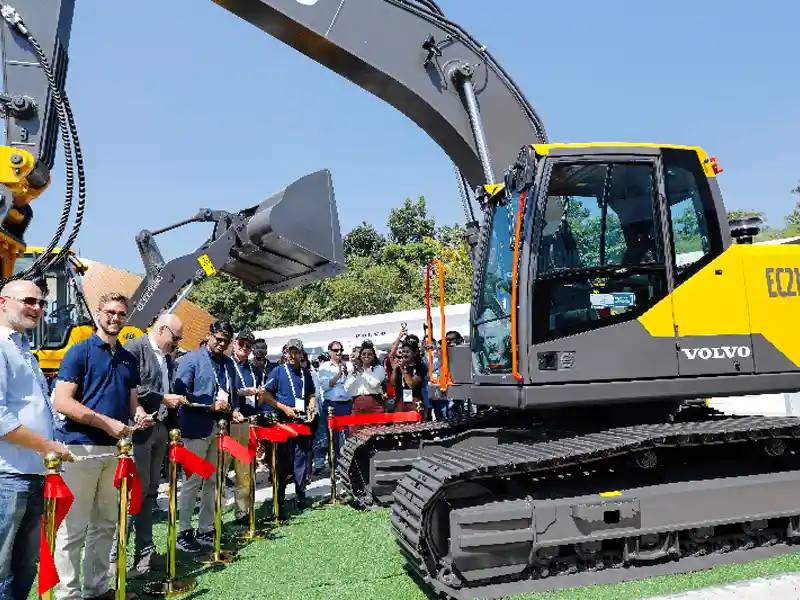
“Following the successful launch of the EC210 last year, the EC215 marks Volvo CE’s next leap in delivering high-efficiency medium excavators purpose-built for India’s infrastructure ambitions. It is built on insights gathered from customers operating across India, delivering stronger productivity and improved fuel efficiency,” said Dimitrov Krishnan, Managing Director.
“The EC215 is about 700–800 kg (0.8 tons) heavier than our EC 210, and features a longer undercarriage and a 1.1 m³ bucket instead of the standard 1.0 m³, giving a clear productivity advantage, mainly in quarry applications. Its digging reach remains unchanged, even though our machines already offer one of the highest reach figures in the segment. While most competitors offer a 5.7 m boom with a 2.2–2.3 m arm, we provide a 2.5 m arm, ensuring superior reach and flexibility. Customers generally prefer higher tonnage machines, but there are specific applications where this size makes a real difference,” he added.
“The machine is priced slightly higher than the EC210, but for contractors and rental companies handling longer-duration projects or their own sites, it makes strong commercial sense. Our tagline ‘Zyada Ka Vaada’ extends the company’s philosophy across 20-22-ton class of excavators offering outstanding performance, fuel-efficiency, value, and uptime.“
“The 20-ton excavator segment has declined by around 10–12% over the last year, but Volvo has grown by over 30% in the same period. As a result, our market share has increased, and nearly 80% of our buyers are our new customers. This growth is largely driven by customers who clearly see the value proposition—especially in fuel saving of 2–3 liters per hour, which is substantial, particularly for rental operators running machines 12–15 hours a day. These savings come from our VECV 494 engine combined with Volvo’s positive hydraulic control system, which is unique in the industry.”
Volvo CE also introduced its electric Wheel Loader L120, which is India’s most advanced wheel loader commercially available now, reinforcing the brand’s shift toward zero emission, cost-efficient construction solutions. The showcase included a pre-launch of the EC650, positioned to redefine heavy excavation standards for large construction and mining operations.
The new SD110 Compactor (a Stage V CV5 model) is designed to deliver long-term reliability and high ROI for road building and compaction needs. “This machine is truly an industry benchmark. Volvo pioneered vibratory compaction in India in the late 1980s. This is now the 8th generation of that product. It comes with a ROPS-certified cabin, is extremely robust, and offers very high resale value. Safety is a key focus, with features such as side entry, which is rarely seen in this segment,” informed Krishnan.
“Traditionally, machines use negative control hydraulic systems, but Volvo uses positive control, where the hydraulic pump responds strictly to demand. So, when a function is activated or deactivated, the pump speed adjusts instantly, reducing unnecessary power consumption. This results in lower fuel burn, typically around 2 liters per hour, and in some applications, even 3 liters per hour. We track all our machines digitally, so these numbers are data-backed.”
Volvo CE offers a full range of buckets and breakers, and the more advanced drum cutters and diaphragm wall equipment which can be installed through approved suppliers. “Volvo machines are often the preferred base machines for attachments due to their high hydraulic capacity and excellent controllability.”
“Volvo continues to deliver solutions that address the real needs of the Indian market. With our compactors and electric wheel loaders on display, we are enabling customers to transition toward technologies that reduce emissions and operating costs. Our commitment is to stay closely aligned with India’s infrastructure priorities and support that journey through reliable, future-ready technology.”
“We believe electrification will continue to grow steadily. From an operating cost perspective, electric machines deliver 65–70% savings in energy costs compared to diesel, which is a major advantage. Volvo CE’s electric machines are gaining acceptance primarily in the wheel loader segment. This year, wheel loader sales in Indian CE industry is about 15-17%. Sagar Cements in Andhra Pradesh, for instance, has deployed three Volvo L120 electric wheel loaders.”
“The initial concerns regarding the higher upfront cost of electric machines have largely disappeared. We now have machines operating for 12,000–14,000 hours with no noticeable battery degradation, since they are designed for approximately 4,500 charging cycles, translating to 7–8 years of operational life in most applications. Even after that period, battery performance typically drops by only 25–30%, which aligns with the reduced usage of an older machine.”
Volvo CE created an immersive brand experience by demonstrating its holistic service ecosystem, including Equipment-as-a-Service offerings, digital machine monitoring, operator skill development tools, productivity management solutions, and live support services. These solutions are designed to maximize fleet utilization, minimize downtime, and ensure sustained machine performance throughout the equipment lifecycle.
The company also announced its progress on the upcoming Technology Centre in Bengaluru, which will focus on R&D, localization, and product development for both India and global markets. “This strategic investment positions India as a key contributor to Volvo CE’s global innovation network and reinforces the company’s role as a thought leader in advancing safety, performance, and sustainability standards across the construction equipment industry,” said Krishnan.
“Our focus remains on productivity, fuel efficiency, safety, and sustainability. Whether it is advanced hydraulics, electric solutions, or application-specific designs, Volvo CE continues to deliver value that customers can clearly measure on their balance sheets,” he concluded.