Key regional insights
Companies see an opportunity to reposition logistics portfolios
Much of the region’s stability in H1 2025 may also reflect strategic front-loading of shipments ahead of tariff deadlines, raising questions about occupier demand in the coming months. Companies are now reassessing costs and operational flexibilities to optimise their logistics portfolios.Tim Armstrong, global head of occupier strategy and solutions, Knight Frank, explains, “As firms weigh their strategic priorities, real estate portfolios are increasingly being reconfigured to support more resilient, regionalised supply chains. This includes investment in distribution hubs, proximity to ports or multimodal transit networks, and the integration of logistics infrastructure with office and support functions.
Occupiers are likely to focus more resources towards establishing bigger and more efficient logistics hubs close to urban areas while right-sizing those in less strategic locations. This trend is already evident in Australia, where occupier demand has gravitated towards prime areas, such as Brisbane’s Trade Coast. As rental growth in the region continues to moderate, the current window represents an opportunity for occupiers to strategically position their portfolio for long-term growth.”
Chinese mainland shows signs of stabilisation
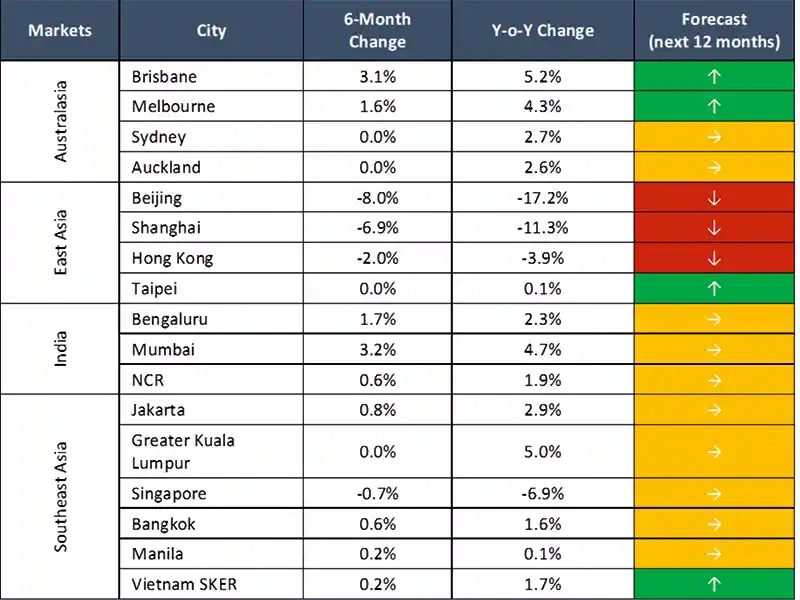
Chinese mainland markets, which have been under pressure, showed encouraging signs of recovery. Rental declines moderated significantly to 12.8% year-on-year from 14.1% in H2 2024, supported by government stimulus measures that boosted demand for digital devices and logistics services. Total stock in Beijing and Shanghai reached approximately 20 million square meters, though vacancy rates climbed to 27.3%. In Hong Kong SAR, a healthy supply pipeline through 2027 is expected to keep rents under pressure, even as leasing velocity remains subdued.Looking ahead, Shanghai is expected to see narrowing rental declines in late 2025 as supply peaks pass, though Beijing faces continued pressure with an additional 2 million square meters scheduled for delivery in H2 2025.
Chistine Li, head of research, Asia-Pacific, Knight Frank, says, “While rents have continued to dip in Chinese mainland markets, further deceleration across the rest of the region have dragged rental growth into negative territory. We believe this to be largely due to occupier caution, as there has not been a significant deterioration in the region's fundamentals. As occupiers explore relocations or dual logistic strategies to mitigate cross-border tariff risks, India, with a more competitive tariff structure as well as lower costs, is emerging as an important node in China-plus-n strategies. Occupiers in the region can be expected to remain agile in adapting and evolving their supply chain strategies to weather the shifting geopolitical landscape. While expansions plans will be put on hold, we expect selective demand to remain sustained in emerging Southeast Asian markets and India.”
Market outlook and strategic implications
Although conditions in logistics occupational markets in the region have remained stable so far, part of this stability may be attributed to the frontloading of shipments ahead of tariff deadlines, as occupiers strategically advance inventory to avoid additional costs. As the effects of these pre-emptive moves taper off, the region is likely to see a period of recalibration.The increasingly complex dynamics, ranging from shifting supply chains and evolving geopolitical tensions to fluctuating trade policies, will continue to weigh on occupier activity in the latter half of the year. Businesses are expected to reassess their logistics footprints, weighing the imperative to control costs against the need for operational efficiency and the pursuit of long-term growth opportunities.