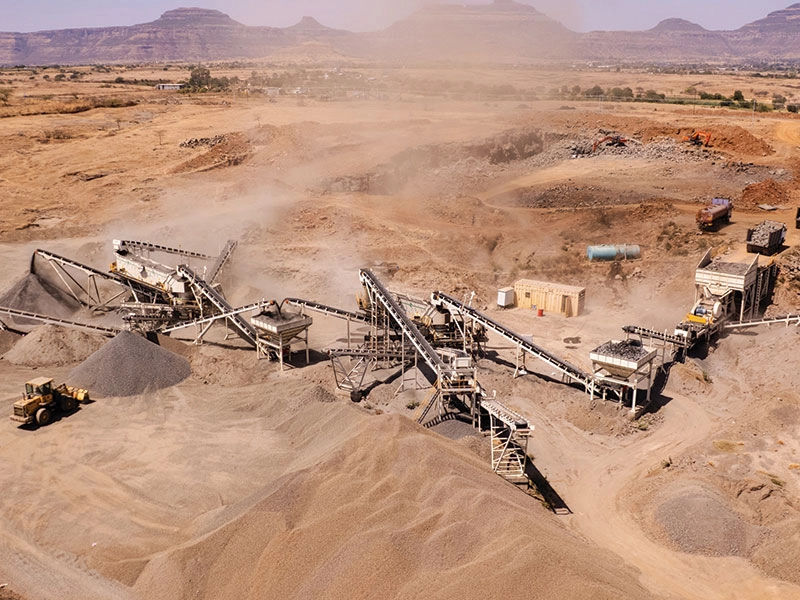
The deployments span road construction in a northeastern hill state, a remote mini hydropower project in the far eastern region, and a coal trading and handling facility in coastal Andhra Pradesh.Together, they address a core operational gap in the Indian construction, mining, and material-handling ecosystem: the inability of fixed crushing plants to follow the work front, operate without power infrastructure, and run on minimal crew.
Case 1: Road Construction, Northeastern Hill State
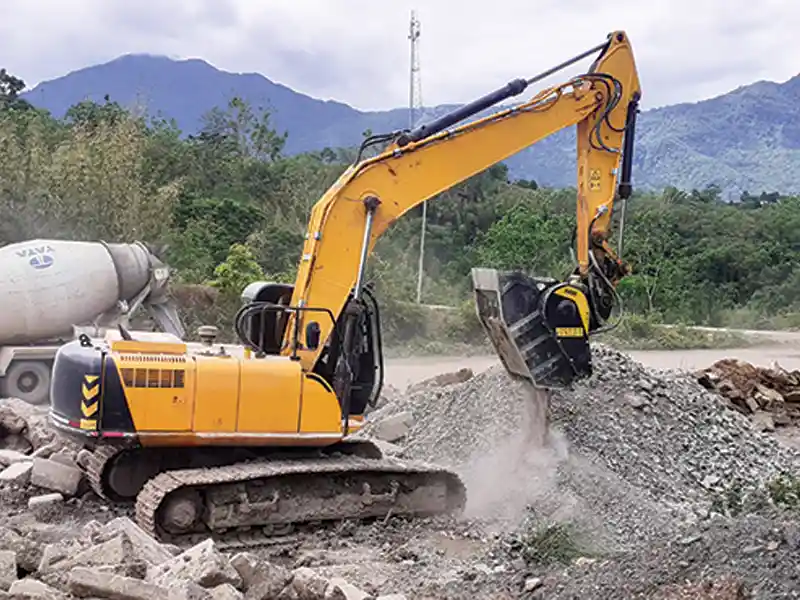
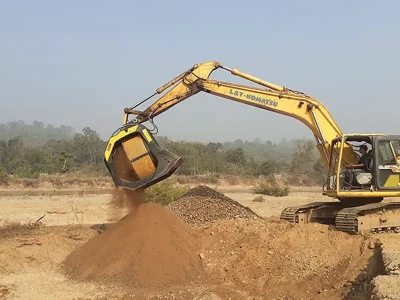
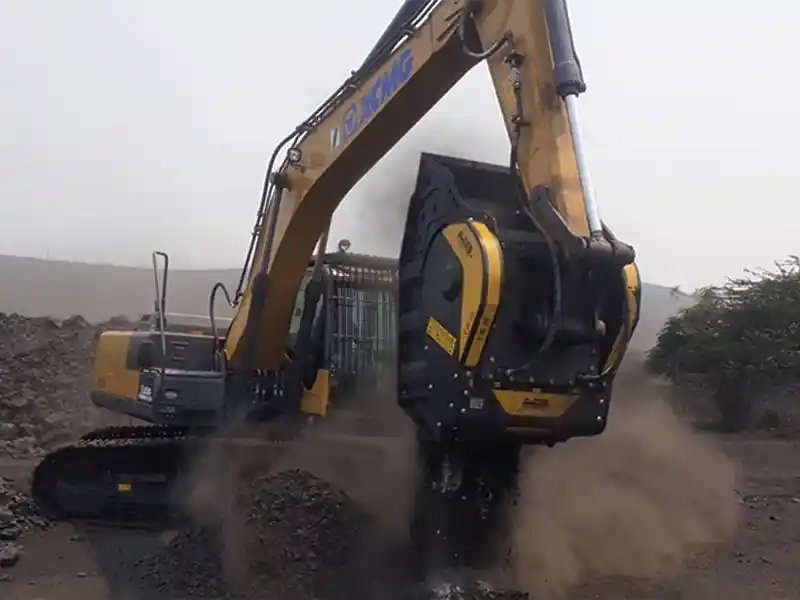
A civil contractor handling road construction across a 20-plus kilometre mountain stretch replaced a 120 TPH stationary jaw crusher with a combination of three MB Crusher attachments: BF60.1 and BF70.2 crusher buckets, and an MB-S14 screening bucket, all mounted on existing excavators.The stationary plant required advance logistics for every relocation, a dedicated power source, and a separate labour crew. In hilly terrain with local stone as feed material, frequent jaw choking and unplanned stoppages added to project delays. Post-pandemic labour scarcity made a multi-person crushing crew operationally unsustainable.
Following deployment of MB attachments, the operation was reduced to a single operator per excavator, which were anyway also required for fixed plant operations. The crushing unit now moves with the work front. River stones are crushed to 50–60mm down material directly at the extraction point, eliminating secondary haulage. Over 20 km of road work has been completed using this setup.
Case 2: 2 MW Mini Hydropower Project, Far Eastern Region
A site engineer overseeing a 2 MW mini hydropower project in the far eastern hill states deployed the BF90.3 crusher bucket on an existing on-site excavator to produce 20mm and 40mm construction aggregate from locally blasted rock.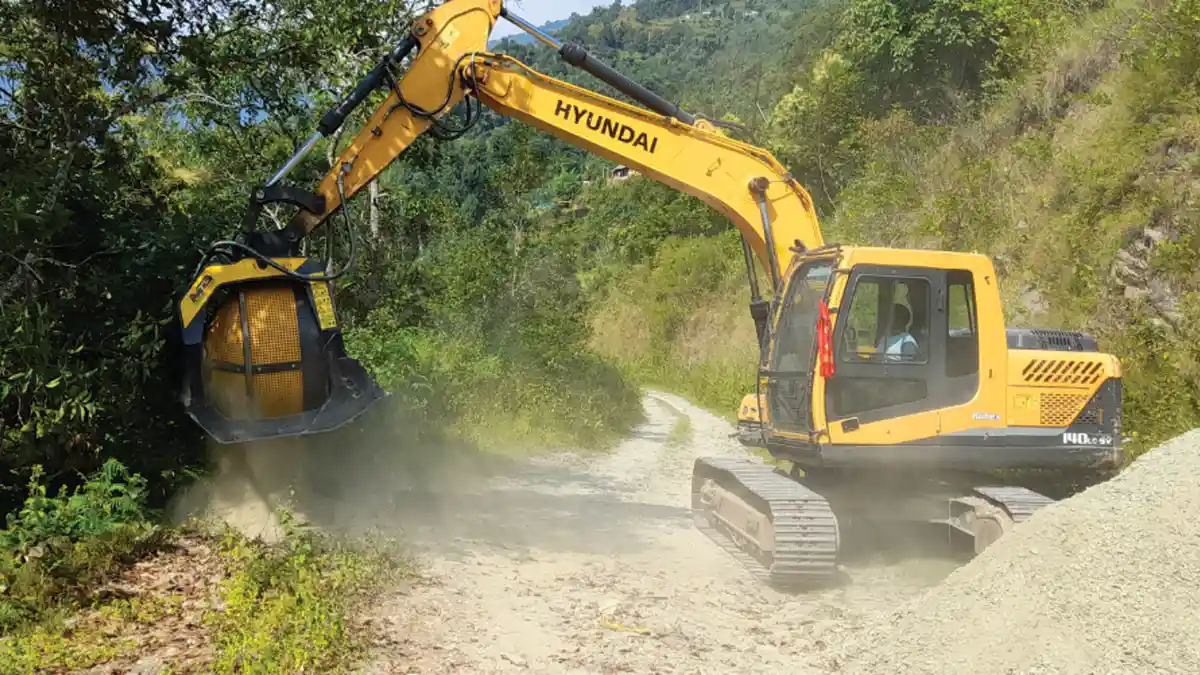
The site had no grid power, no serviceable access road for heavy haulage, and no nearby source of processed aggregate. Purchasing and transporting crushed material would have cost multiples of on-site production cost per tonne. A diesel generator-driven crusher was evaluated but rejected due to additional fuel burden and maintenance complexity with no local service infrastructure available.
The BF90.3 runs entirely off the excavator’s hydraulic circuit, requiring no external power, and no additional fuel consumption of the excavator compared with its normal operations. The existing operator managed both excavation and crushing cycles. The site produced specification aggregate throughout the project duration with no critical downtime events.
Case 3: Coal Trading & Handling Facility, Coastal Andhra Pradesh
A coal trader operating a yard in coastal Andhra Pradesh deployed the BF90.3 crusher bucket to eliminate a structural overhead: the secondary handling cycle required to move oversized coal lumps from the intake yard to a fixed crushing point before dispatch.Every incoming consignment required an additional handling pass — additional machine time, fuel, and operator hours — before the coal was ready for dispatch. The existing fixed crusher could not follow incoming material across a dynamic multi-zone yard.
After mounting the BF90.3 on the yard’s existing excavator, the operator began crushing oversized coal inline during the intake and stacking cycle. The dedicated secondary handling pass was eliminated entirely. The crusher now moves to wherever coal is being unloaded, removing the fixed-point bottleneck.
“These three sites represent conditions that most fixed crushing plants simply cannot serve — no power, no access, no stable location. The results confirm that attachment-based crushing is not a compromise for Indian contractors. It is, in many cases, the only method that works.”
— MB Crusher India’s Technical & Sales Team
Why This Matters for the Indian Market
India’s construction sector is expanding rapidly into terrain and project types where fixed crushing infrastructure is not viable — highway projects in hilly states, urban works, rural road contracts under PMGSY, remote hydropower and irrigation works, and port-side commodity handling. The constraints are consistent: no grid power, no space for fixed plant, urban constraints, no stable work location, and limited skilled manpower.An excavator-mounted crusher bucket addresses all five simultaneously. It draws power from the carrier’s hydraulic circuit, occupies no additional footprint, relocates in minutes, and runs on the operator already in the cab. Across the three cases documented, these characteristics translated directly into eliminated logistics costs, power requirements, reduced crew requirements, with tangible payback periods under 12 months.
For contractors bidding on stretch-based road contracts, EPC companies executing remote infrastructure, and commodity handlers managing variable incoming material — the economics of attachment-based crushing are now field-verified in Indian conditions.