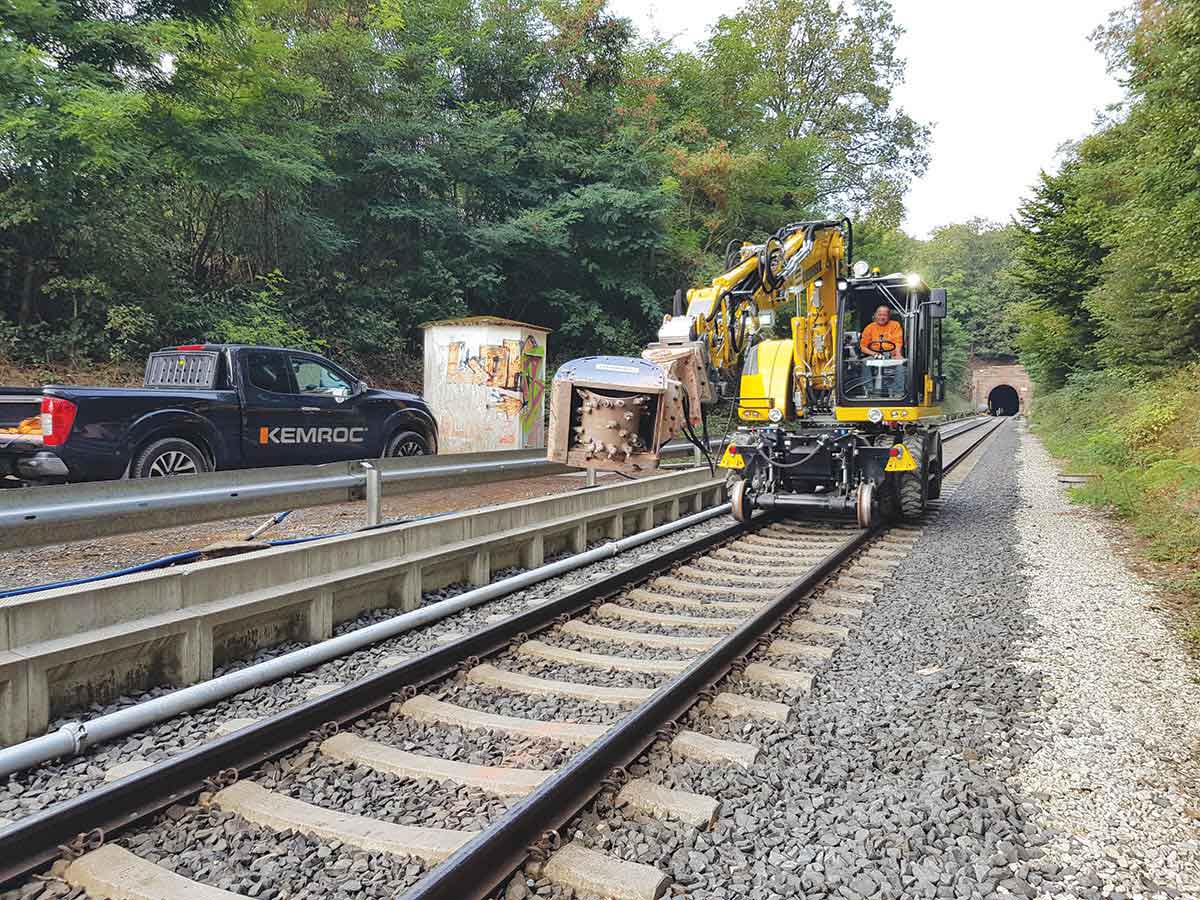
 At the Hasselborner tunnel renovation project in central Hessen, Baresel used a KEMROC patch planer mounted on a railway excavator.
All photos: KEMROC
The 1,300 m long Hasselborner tunnel in Central Hesse, Germany, has a long history. Constructed between 1910 and 1912, the lower section of the tunnel was natural stone while the tunnel crown was constructed with masonry bricks. Today, the single track, non-electrified railway tunnel is located on the Taunus line connecting the towns of Grävenwiesbach and Hasselborn, to the west of Frankfurt am Main. After about 100 years in operation, renovation of the tunnel lining was necessary to prevent water seeping into the tunnel and maintain safety standards to ensure a working life of another 50 years. The contract for this work was granted by the client, HLB Basis AG (Frankfurt am Main), to contractor Baresel GmbH (Leinfelden-Echterdingen), who has earned an extremely good reputation for tunnelling and renovation projects.